-
 "Elizabeth, you should have"
 A three-page draft of an unfinished, untitled poem from winter 1992 addressing Elizabeth Bishop. It is an "uncharacteristically awkward" but powerful poem about "raw life" prevailing over "graceful art."
-
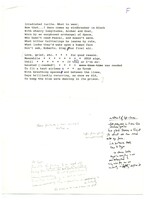 "Self-Portrait in a Tyvek Windbreaker"
 Holograph and typescript fragments toward and three full drafts of "Self-Portrait in a Tyvek Windbreaker." A play on John Ashbery's "Self-Portrait in a Convex Mirror," and published in A Scattering of Salts, it is one of the longest poems of Merrill's later years and one of the strongest from any phase of his career. "...it is concerned not with personal memory, but with the present and the future of our culture."
-
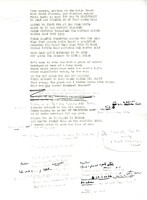 "The Will"
 "The Will," published in Divine Comedies, contains the first mention of Ephraim in a poem, as well as the first time he speaks. In it, Ephraim explains why the novel draft was lost twice--implying that he was involved.
-
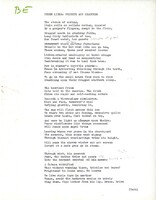 "Under Libra: Weights and Measures"
 "Under Libra: Weights and Measures," published in Braving the Elements, was dedicated to David McIntosh. Included here are two corrected typescript drafts of the poem. Through this seemingly impersonal poem Merrill realized, with the help of his therapist, that his life and art are equally present and giving each other meaning.
-
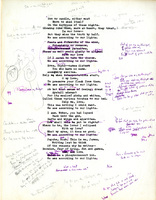 "From the Cupola"
 This typescript draft page (one among 265 draft pages) centers on James Merrill comforting Psyche (and himself) over her (and his) realization of the limitations of love and self-knowledge. "From the Cupola" was published in Nights and Days. See also February 18, 1965 note to Irma Brandeis.
-
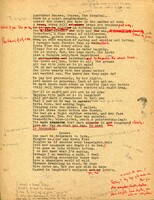 "Days of 1964" draft
 Two typescript draft pages (of a total thirty-two manuscript pages) with holograph corrections, drafts, and sketches. The poem documents his life in Greece and love for Strato Mouflouzelis.
-
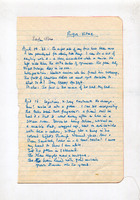 "The Thousand and Second Night"
 Notebook pages showing the first title of and early notes toward the pivotal, experimental, multifaceted poem "The Thousand and Second Night," which was based partly upon Merrill's Bell's palsy experience. These notes capture Merrill's uncertainty what is happening to his half-paralyzed face, and his realization the condition can be a metaphor for his soul. These are just three of a total sixty-eight manuscript pages in the collection. The drafts includes pages toward a pseudo quote about the soul and abuse of the earth, two major themes of the epic Ouija board poems that came later.
See also the photograph of Maria Mitsotaki and James Merrill.
-
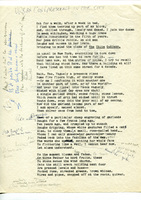 "An Urban Convalescence"
 This entry includes two typescript draft pages (among the 40 worksheets Merrill saved) with holograph corrections and drawings showing his "engagement in verbal self-analysis" and reflecting "the intimate, brooding voice in Merrill's notebooks." The finished poem shows the early influence of Elizabeth Bishop and a reaction to Robert Lowell and Confessional poetry. "An Urban Convalescence" was published in Water Street.
-
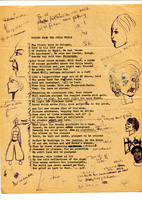 "Voices from the Other World"
 "Voices from the Other World," published in The Country of a Thousand Years of Peace, was James Merrill's first--and for many years, only--treatment of the Ouija board séances in a poem. Merrill's supernatural and domestic life with Jackson both enter his poetry here as subjects for the first time. Included here are two double-sided pages from a total of 27 draft pages, which show Merrill's fondness for doodling faces--especially female faces--as he composed poems.
-
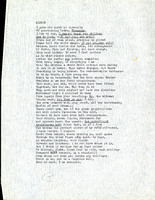 "Mirror"
 "Mirror" was published in The Country of a Thousand Years of Peace. Included here is one typescript among 11 total pages with holograph notes and alternative titles. It was inspired by the Ephraim séances and is commonly held to be Merrill's "strongest, most original poem in the 1950s."
-
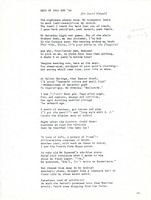 "Days of 1941 and '44" draft
 Published in Late Settings, "Days of 1941 and '44" recalls Lawrenceville School and Merrill using his diaries to become a "poet of memory." The poem is dedicated to David Mixsell, his arch-nemesis at Lawrenceville, who died on D-Day in World War II.
-
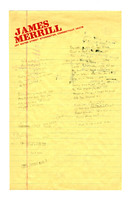 "Days of 1935" draft
 Published in Braving the Elements, "Days of 1935" was a fantasy narrative about being kidnapped as a boy, a la the "Lindbergh baby," reflecting a real fear the wealthy had after the kidnapping and death of Charles Lindbergh's infant son, in 1932. Rather than being scared by his kidnappers, however, the young narrator ends up being fascinated and even appreciative of them. The comic poem represented Merrill's adult understanding of his adolescent need for attention and escape, and of his budding sexual identify.
-
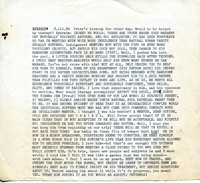 March 8, 1986 séance
 During the March 8, 1986 séance James Merrill gets relationship advice from Ephraim concerning Peter Hooten, with mention of the fight that led to Merrill pushing Hooten into the pool.
-
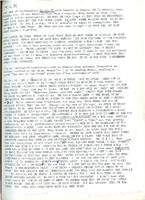 March 29 & April 26, 1976 Séances
 During the March 29 and April 26, 1976 séances, higher powers (over Ephraim) began revealing the cosmology that Merrill would document in Mirabell: Books of Number and Scripts for the Pageant. It was during this time period, after finishing "The Book of Ephraim," that Merrill realized many more revelations were yet to come. In the March 29 seance, Stephen Yenser is participating with Merrill and Jackson.
-
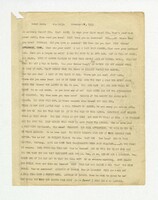 James Merrill and David Jackson's second séance
 James Merrill and David Jackson's second séance (and the first that Merrill transcribed and preserved), in which they reached the spirit of "Kabel Barnes," a colonial farmer.
-
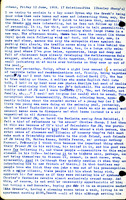 David Jackson Journal
 Journal entry by David Jackson about jealousy and promiscuity between James Merrill and Jackson.
-
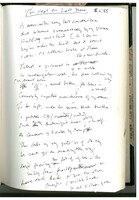 Journal 50 - Last Poem Draft
 Journal 50 contains Merrill's last poem draft, called "The Next to Last Scene," scribbled down (without his glasses) the day before he died of a heart attack. It was unusual for Merrill to title the first draft of a poem in his notebook.
-
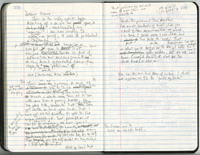 Journal 47 - Letter to Hellen Plummer
 A draft of a letter to Merrill's mother, Hellen Ingram Plummer, to prepare her for the publication of his memoir, A Different Person, which contained elements of his life he knew would be unsettling to her.
-
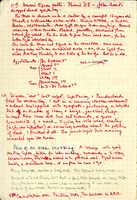 Journal 16 - HIV Diagnosis
 Journal 16 captures the visit to the Mayo Clinic during which Merrill was tested for HIV and received the diagnosis of HIV positive. The entry includes haikus, some of which would appear in "Prose of Departure," a 14-part haibun poem.
-
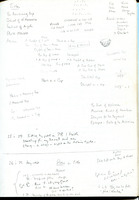 Journal 14 - Notes on Title for The Changing Light at Sandover
 James Merrill's notes on a possible title for the Ouija trilogy, eventually titled "The Changing Light at Sandover."


