"Key West Aquarium: The Sawfish"
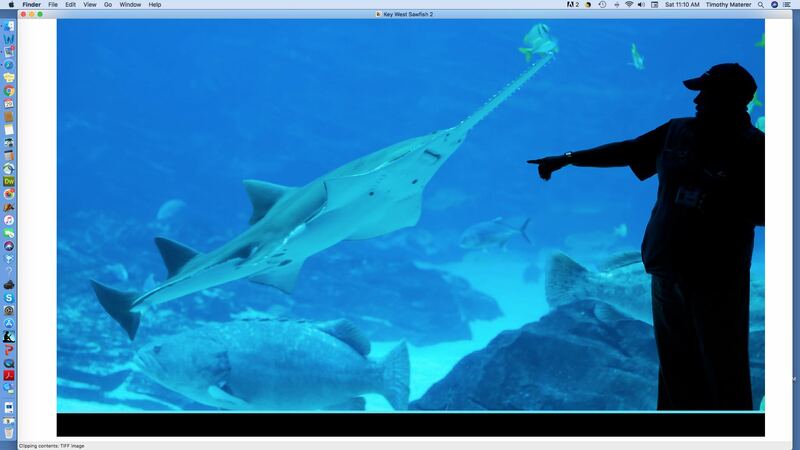
Key West Sawfish 2
"I tried to signal to this person: Look! I'm not what I seem, I'm a man like you! . . . The stout man broke into smiles and pointed me out to his neighbors—voyez donc, a fish who imagined he was human, what next!" (James Merrill: Collected Prose, 555-56).

A sonnet is a moment's monument.
—Dante Gabriel Rossetti
James Merrill wrote "Key West Aquarium: The Sawfish" in February 1989, but it was not published until the 2001 Collected Poems. Merrill's sonnet might have gained more attention had it appeared in A Scattering of Salts (1995) rather than after his death. Edmund White called Merrill a "modern master of the sonnet"(Arts and Letters). Sonnet sequences, such as "The Broken Home," "Matinees," and "The Will," as well as sonnets throughout The Changing Light at Sandover, support White's claim; and "The Sawfish" demonstrates Merrill's command of the form. Although it draws on the stanzas and rhyme schemes of both the Shakespearean and Italian sonnet forms, its emotional power arises from the Shakespearean turn it takes from octave to sestet as well as the subtlety of its concluding couplet. As in Shakespeare's Sonnet 30, thoughts of a "dear friend" make "sorrows end." In Merrill's poem, however, the stated resolution seems unlikely to last.
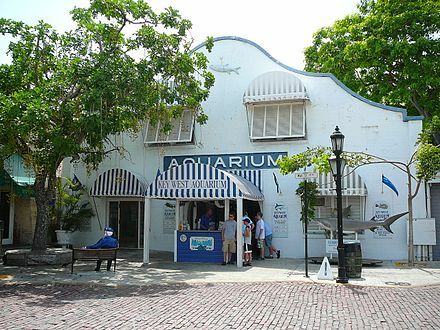
"The Sawfish" commemorates Merrill's visit to Florida's Key West Aquarium with a new friend, a college student taking a winter break. The manuscripts reveal the poem began with two quatrains on a note card (Manuscript 4) dedicated "for Brian from James, K[ey] W[est] 9. ii. 89." The note card belongs to a type of Merrill's verse that Washington University has featured on its Special Collections website "Occasional Verse": "poems expressed as party invitations, birthday sentiments, holiday wishes, love notes, get-well cards, epithalamia, postcards, and accompaniments to gifts." To develop these quatrains, he added six lines in which the poet both identifies with the sawfish and speaks for him. Merrill also experimented with the first two quatrains in a poetic sequence devoted to "Unlovely Fauna" (for example, Manuscript 17) that features mosquitoes, some kind of slug or snail, and the sawfish.
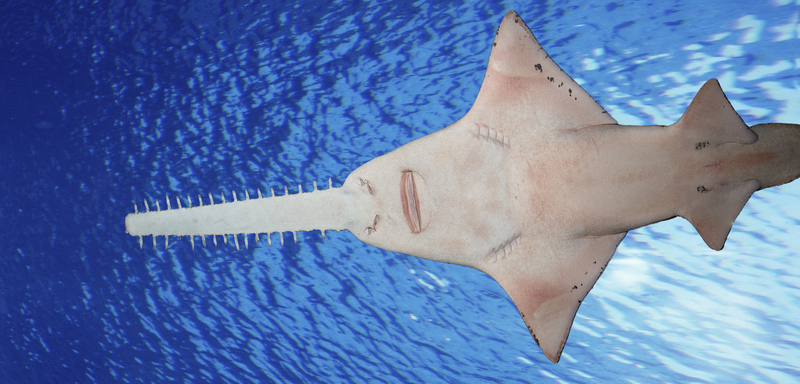
In the opening lines, the poet identifies with the unlovely sawfish. The theme is characteristic of Merrill's poems about isolation such as "The Octopus," in which the speaker is trapped in a "glassen surface," or his sonnet "Think Tank," where the poet seems enclosed within the "trick / Reflections" of a fish tank, which echoes Merrill's recurrent dream of being trapped in an aquarium. "The Sawfish" resembles some of Merrill's late poetry, such as "Christmas Tree," in reflecting on aging and declining health. The sawfish displays the "Flat white lips of a ghost or libertine." In Manuscript 3 the appearance of the sawfish is "Bloodless & flat like Oscar Wilde's." In Manuscript 13 he confesses to being a "sad youth-haunted ghost," with "white hair, [and] lips that once kissed and told," as he did throughout his poetic career. The finished poem softens some of the self-criticism in the manuscripts though it retains terms such as "frightful mouth" and adds that the Wildean fish is "Bored in mid-swim."
The sonnet's emotional turn comes as the octave concludes and the bored fish sees the speaker's companion as a "sunbeam fills" its mouth. In the positive sense of the word, the fish is "bored" through by a sunbeam that appears at the sight of the speaker's companion. As in the Renaissance tradition, the beam of the eye is a physical thing. The poet is now inspired to "speak for . . . [his] fellow captive." He is like the speaker of the late poem "Oranges," who feels like an "empty rind" that nevertheless was once "Made up of taste and sunlight," like the nearly transparent sawfish that can still "admit light." When the "bright shaft glides" through the sawfish's mouth to fill him with light, it disproves the old saying, "Love's but a dream and only death is kind."
The dismissal of conventional wisdom about love and death is the kind of sudden emotional turn one sees in Shakespeare's sonnet 30 when the speaker shakes off his depression thanks to the thought of his friend: "All losses are restored and sorrows end." However, for Merrill the assertion is not so smoothly made. The poem's meter is iambic pentameter but with exceptions that roughen it. When the sawfish is imagined pausing at the sight of the speaker's companion, the dash in the eight syllable line slows the rhythm: "He sees you—and a sunbeam fills . . . ." In another abbreviated line, he shows his hesitation about calling himself a ghost with "lips that kissed and told" and
Declare me—well, almost—
Not of this world, transparently a ghost
If he's transparent, however, he can still like the sawfish "admit light." In the poem's final lines a regular iambic rhythm is traditionally and brilliantly employed to emphasize the word "Love" in the one reversed foot in the couplet:
One old
Disproven saw sinks out of mind:
Love's but a dream and only death is kind.
This affirmation of love is nevertheless qualified as it plays against the sonnet it completes. Taken in itself, the final line is a definitive statement of the melancholy wisdom one finds throughout Merrill's "chronicles of love and loss." Merrill's most renowned love poem, "Days of 1964,"recognizes that love might be merely "illusion." The darkness of "The Sawfish is broken only for a moment as the "bright shaft glides." Yet it's a moment of brightness shared with a friend and captured in a sonnet.
5 November 2019
Note: See the letters to Brian Walker in A Whole World: Letters from James Merrill, Ed. Langdon Hammer and Stephen Yenser. NY: Alfred A. Knopf, 2012.