Wilson Price Hunt (1783 -1842) owned land on what is now Tyson property according to plat maps from 1838 and 1847. He moved to Missouri in 1804 and formed the Pacific Fur Company with John Jacob Astor in 1810. Hunt traveled to trade in Hawaii, Alaska, and California. He returned to St. Louis in 1817 and farmed and developed a parcel of land southwest of the city until his death. President Monroe appointed Hunt the Postmaster of St. Louis in 1822, a position he held until 1840.
Wilson Price Hunt and his wife Anne Lucas Hunt (m. 1836) were enslavers. In 1840, Hunt held four people in slavery. Anne Lucas Hunt was the widow of Wilson’s brother, Theodore Hunt, and the couple may have inherited people whom Theodore Hunt had enslaved. After Wilson Hunt's death, Anne Lucas Hunt continued to hold people in slavery, enslaving eight people in St. Louis Ward 3 in 1850 and St. Louis Central Township in 1860. A twenty-year-old man enslaved by Anne Hunt who had just been baptized died on April 29, 1844. In 1845 Anne Hunt held five people in slavery at St. Louis city block 181. She held one person in slavery in 1850 in Carondelet, and in 1855, Mary Rose, a 13-year-old Anne Hunt enslaved was baptized at Saint Francis Xavier College Church in St. Louis. In 1860 Anne Hunt enslaved three people in the central township of St. Louis.
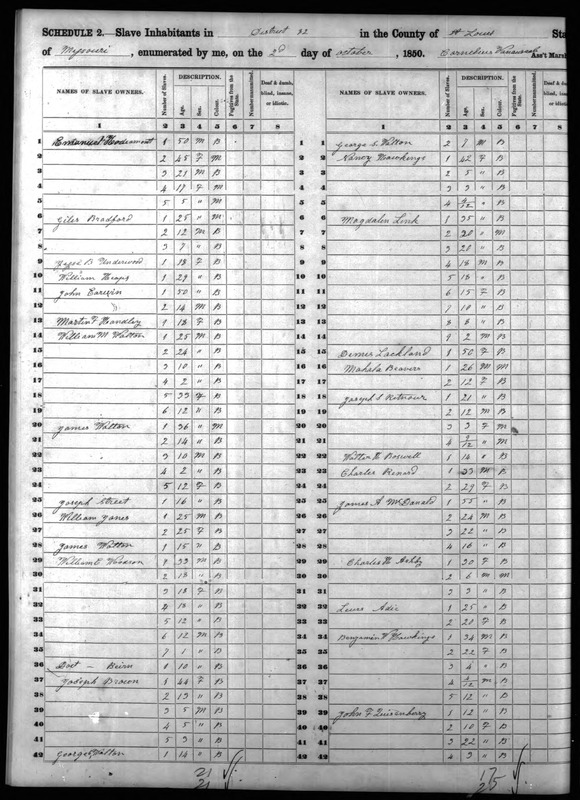
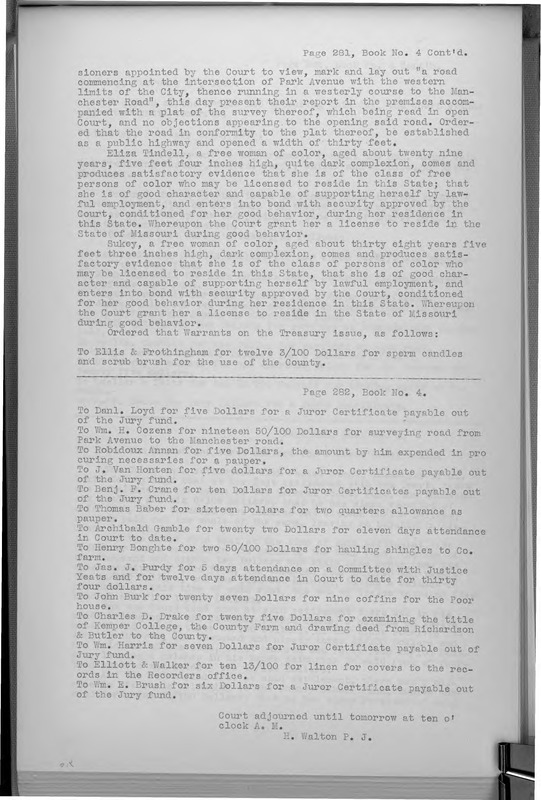
William Walton would have been Cyrene's (Martin F. Hanley's wife) Grandfather. He migrated to the St. Louis Area around 1792 in what is now Overland. According to the census, he had 6 slaves, a 25-year-old female, a 24-year-old male, a 10-year-old, a 2-year-old, a 33-year-old female, and a 12-year-old as of 1850.
William Tandy Christy (1803 – 1883) and Robert Kay Woods (1820 – 1874) owned a dry goods business named William T. Christy & Company in Murfreesboro, Tennessee. As their business began to grow too big for the small town of Murfreesboro, they moved their company to downtown St. Louis and renamed the business Woods, Christy, & Company while continuing to grow their dry goods business. After moving to St. Louis, Christy and his employees later discovered high quality fire-clay while digging on the family farm. In 1856, Christy began mining the clay and started a fire clay plant and formed the Christy Fire Clay Company. Additionally, Woods and Christy owned and assembled the lands that are now Rockwoods Reservation and Greensfelder Park in Pacific, Missouri. On this land, Christy and Woods formed a lumber company which logged the area, suggesting the land at Tyson which Christy and Woods owned in 1862 was potentially used for logging or clay mining to support their business.
Both Christy and Woods were enslavers. In 1830, Christy enslaved nine people in St. Louis. The 1840 census documents that he enslaved five people in St. Louis Ward 4, as well as in the 1845 city census in block 98. By 1850 Christy enslaved five people in Ward 4, and in 1860 Christy held seven people in slavery in St. Louis Ward 6 and twelve people in Carondelet. Woods held three people of slavery at block 126 of St. Louis in 1845, and two people in St. Louis Ward 3 in 1850. In 1860, Woods enslaved one person in Meramec and three people in St. Louis Ward 6.
Following the Louisiana Purchase, Thomas Jefferson appointed Willam Russell (1778-1867) as deputy surveyor for the new American territorial government in 1804, replacing Antoine Soulard. Over time, Russell bought many of the lands he charted, including at what is now Tyson Research Center, and became a large landholder. He purchased approximately 300 acres of land in what is now Alton, Illinois, in April 1815, and donated ten acres to the state for the construction of the Illinois State Penitentiary in 1829. His daughter, Ann Russell, and her husband, Thomas Allen, inherited Russell’s properties and continued to accrue wealth on their investments and sales of his properties.1
William Russell was an enslaver. The enumeration of the 1840 US Census for St. Louis records twelve people enslaved by Russell, and the St. Louis city census of 1845 documents sixteen people. On October 1, 1847, Russell issued a reward for the capture of the Reed family, who had sought freedom from Russell. Russell’s orchard ledger also refers to enslaved people, including Washington Reed, John, and Robert, who helped procure and plant trees, and to whom Russell gifted each a tree.
Co-founder and third Chancellor of Washington University. Contributed to public education in St. Louis; not a staunch abolitionist despite common belief; writings show complex views on abolitionism and slavery-related events; involved with Western Sanitary Commission.
William Dings was born in 1841 and died in 1924. During the Civil War, Dings served for the Confederacy as Captain of Company C, 8th Missouri Infantry. After the Civil War ended in 1865, Dings returned to St. Louis and farmed. He is listed on an 1870 plat map as owning land in what is now Tyson Research Center. Dings’ father Fred Dings was an enslaver and the 1860 Census lists two women aged 28 and 18, a 4-year-old girl, and a 5-year-old boy as being enslaved by him.
According to plat maps, William C. Byrnes (1827-1902) owned land in 1870 that is today part of Tyson Research Center, which he inherited from his father, Samuel Byrnes. His family is the namesake of the Burns-Stuart Cemetery on the south side of the Tyson property.
Washington Walter held land on what is now Tyson Research Center according to an 1838 plat map. Little is yet known about Walter beyond a land grant issued to Walter for this area in 1825.
Walter Moran Farmer was one of the most significant early Black students at Washington University and the first Black graduate of its law school, earning his degree cum laude in 1889. His achievement was remarkable but marred by racism; his white classmates refused to walk with him at graduation, a stark reminder of his unwelcome status despite his success. Farmer went on to a pioneering legal career, becoming the first Black lawyer to argue before the Missouri Supreme Court and one of the first to appear before the U.S. Supreme Court. In St. Louis, he emerged as a respected civic leader and outspoken advocate against lynching and racial violence, using his legal expertise to fight for justice in his community. In 1892, he was among the prominent Black Missourians who declared a National Day of Prayer and fasting on May 31 in response to widespread lynching violence, an event that drew more than 1,500 people in St. Louis.
William tells the story of how he became the guardian of a child, Lily, whose mother Barbara was a "colored woman." When Lily’s mother, Barbara, died, Lily was given to Judy, Archer Alexander’s wife, to care for. But when Judy died, Archer asked William to care for Lily, which he did. Then William learned that Lily had an older sister, Lizzie, who was in the care of Colonel John Balfour. Colonel Balfour asked William to become legal guardians for both girls, which he did. Colonel Balfour gave William US Bonds to help pay for the girls’ care. William is asking General Sherman to ask his brother John Sherman, Secretary of the Treasury, to help get the money from the bonds so he can use it for care of the girls. William also states that Archer Alexander has been in his service since 1863 when he gave him protection under authority of Provost Marshall. He also says Archer Alexander was the “original of the kneeling slave in the Lincoln Emancipation group by Thomas Ball.” William Greenleaf Eliot to Gen. Sherman.
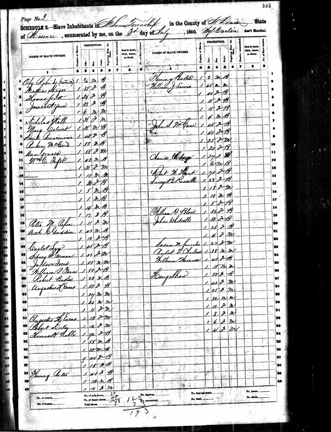
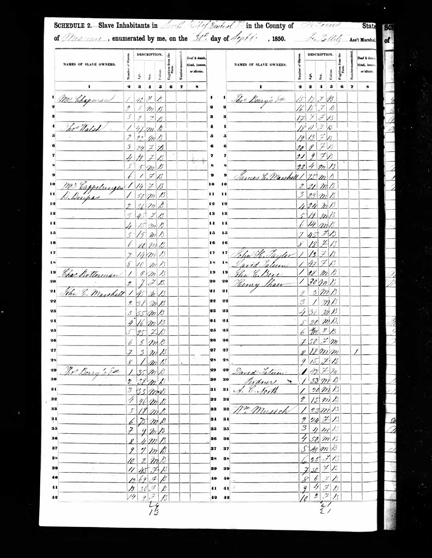
The census describes Shaw to have enslaved:
1. 30-year-old Black male
2. 3-year-old Black male
3. 1-year-old Black male
4. 30-year-old Black male
5. 20-year-old Black male
6. "4/12"-year-old Black female
7. 50-year-old "Mulatto" female
8. 18-year-old "Mulatto" male
9. 15-year-old Black female
Thomas Price owned land in what is now the Tyson Research Center according to an 1846 plat map. In the 1850 census, Price enslaved three people in St. Louis Ward 4. In 1860, the census documents that Price held a fifteen-year-old girl in slavery in Bonhomme.
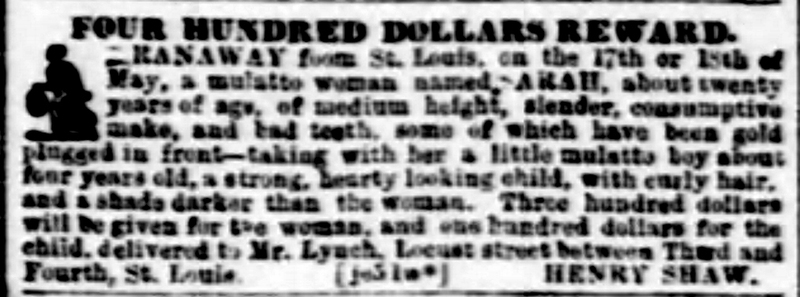
This newspaper advertisement, placed by Henry Shaw, promises a $300 reward for the capture of Sarah and $100 for her son, both of whom Henry Shaw enslaved. Sarah is a "mulatto woman" about twenty years of age, "of medium height, slender, consumptive make, and bad teeth, some of which have been gold plugged in front," and her son is "four years old, a strong, hearty looking child, with curly hair, and a shade darker than the woman."
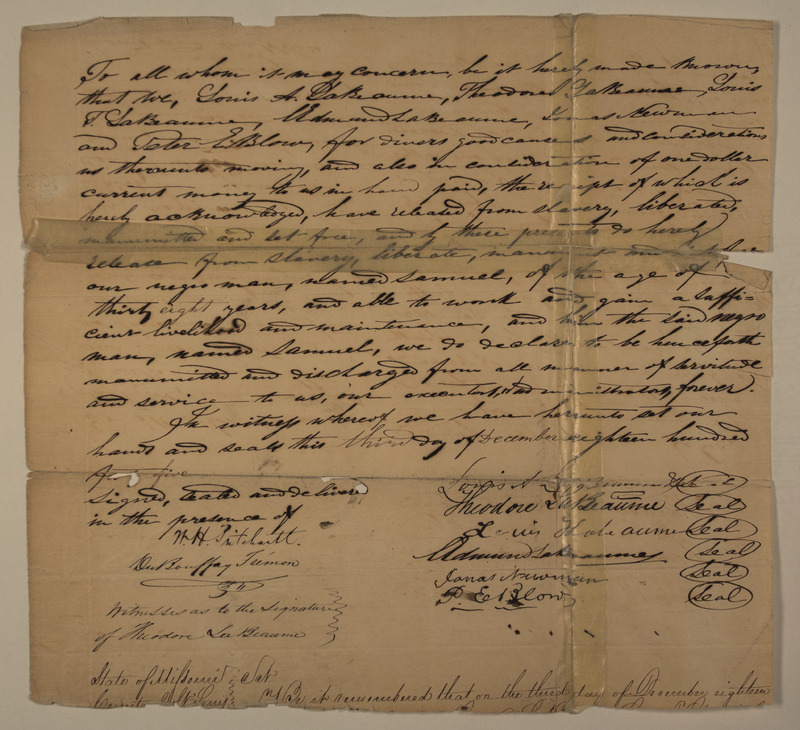
Lesson plan for grades 6-12 educators using 5 records regarding emancipation and the pursuit of freedom within the William K. Bixby Collection. This guide facilitates understanding of the history and legacies of enslavement and abolition and the meaning of self-presentation in this context.
Starks S. Cockrill Sr. (1795-1862), born in Virginia and a veteran of the War of 1812 during which he served as corporal in a Kentucky regiment, moved with his family to Missouri in the 1820s. By 1830, Cockrill held three people in slavery in Bonhomme Township. He received United States land grants in the region on several occasions, including in 1832, 1835, 1840, 1845, and 1853. The families of Starks S. Cockrill Sr., and his sons Christopher Cockrill and Starks Cockrill, Jr., all described as farmers in the 1850 census, lived next to one another in Bonhomme and held nine people in slavery. The families of Starks Cockrill Sr. and Jr. moved to Texas by 1860, but retained land in Missouri according to plat maps of 1862 and 1870. Starks Cockrell Jr. fought for the Confederacy during the Civil War.
Starks Cockrill, Jr., born in 1823 in Missouri, was the second of eight children born to Starks Cockrill, Sr., and the first born in Missouri after the family moved from Kentucky. Cockrill, Sr. obtained land grants on what is now Tyson Research Center Property, and in 1830, the Cockrill family held three people in slavery in Bonhomme Township. By the recording of the1850 census, Starks S. Cockrill Sr., Starks Cockrill Jr., and Christopher Cockrill had all established separate households next to one another and worked as farmers. The families of Starks Cockrill Sr. and Jr. moved to Texas by 1860, whereas Christopher Cockrill continued to live in Bonhomme Township, where he enslaved five people according to the 1860 census and held land on what is now Tyson property according to an 1870 plat map. The Cockrills were enslavers. The 1830 Census for Bonhomme Township lists two girls and a boy aged between 10-23 as enslaved by Starks Cockrill, Sr. In the 1850 Census, he is recorded as enslaving three men aged between 22-35, four boys aged between 4-10, a 30-year old woman and a 2-year old girl in Bonhomme Township. In 1860, "SS Cockrill” enslaved ten people according to the census records for Fayette County, Texas. It is unclear whether that name indicates the father or the son -- one 35-year-old female, and nine males between the ages of 2 and 21. It is likely that both father and son continued to profit from enslaved labor in their farm enterprises in Texas. Starks Cockrill, Jr. served in the Confederate forces during the Civil War.