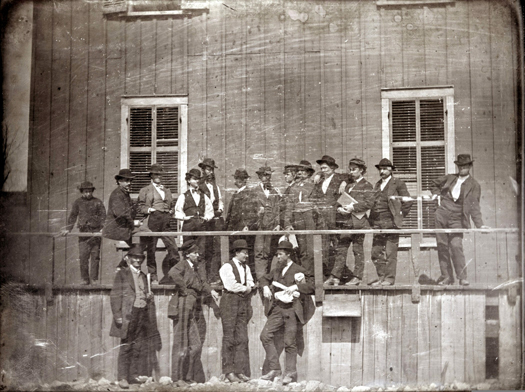
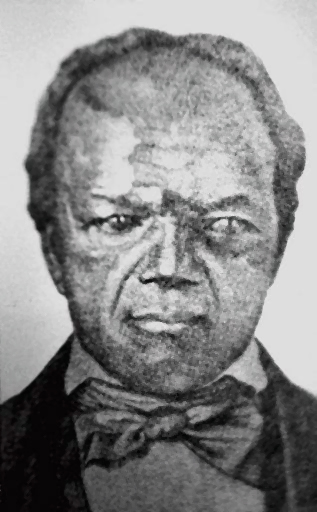
Walter Moran Farmer was one of the most significant early Black students at Washington University and the first Black graduate of its law school, earning his degree cum laude in 1889. His achievement was remarkable but marred by racism; his white classmates refused to walk with him at graduation, a stark reminder of his unwelcome status despite his success. Farmer went on to a pioneering legal career, becoming the first Black lawyer to argue before the Missouri Supreme Court and one of the first to appear before the U.S. Supreme Court. In St. Louis, he emerged as a respected civic leader and outspoken advocate against lynching and racial violence, using his legal expertise to fight for justice in his community. In 1892, he was among the prominent Black Missourians who declared a National Day of Prayer and fasting on May 31 in response to widespread lynching violence, an event that drew more than 1,500 people in St. Louis.
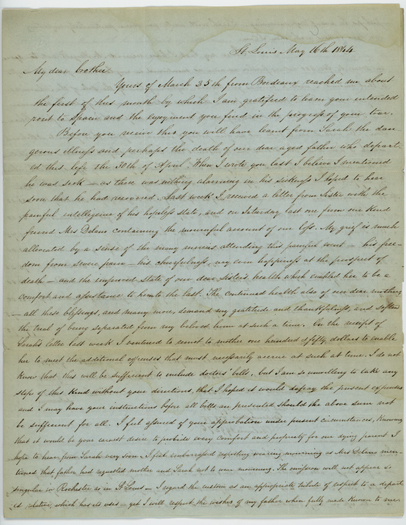
William tells the story of how he became the guardian of a child, Lily, whose mother Barbara was a "colored woman." When Lily’s mother, Barbara, died, Lily was given to Judy, Archer Alexander’s wife, to care for. But when Judy died, Archer asked William to care for Lily, which he did. Then William learned that Lily had an older sister, Lizzie, who was in the care of Colonel John Balfour. Colonel Balfour asked William to become legal guardians for both girls, which he did. Colonel Balfour gave William US Bonds to help pay for the girls’ care. William is asking General Sherman to ask his brother John Sherman, Secretary of the Treasury, to help get the money from the bonds so he can use it for care of the girls. William also states that Archer Alexander has been in his service since 1863 when he gave him protection under authority of Provost Marshall. He also says Archer Alexander was the “original of the kneeling slave in the Lincoln Emancipation group by Thomas Ball.” William Greenleaf Eliot to Gen. Sherman.
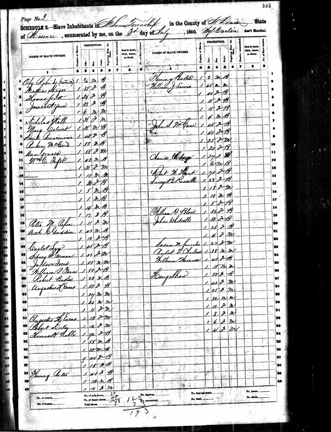
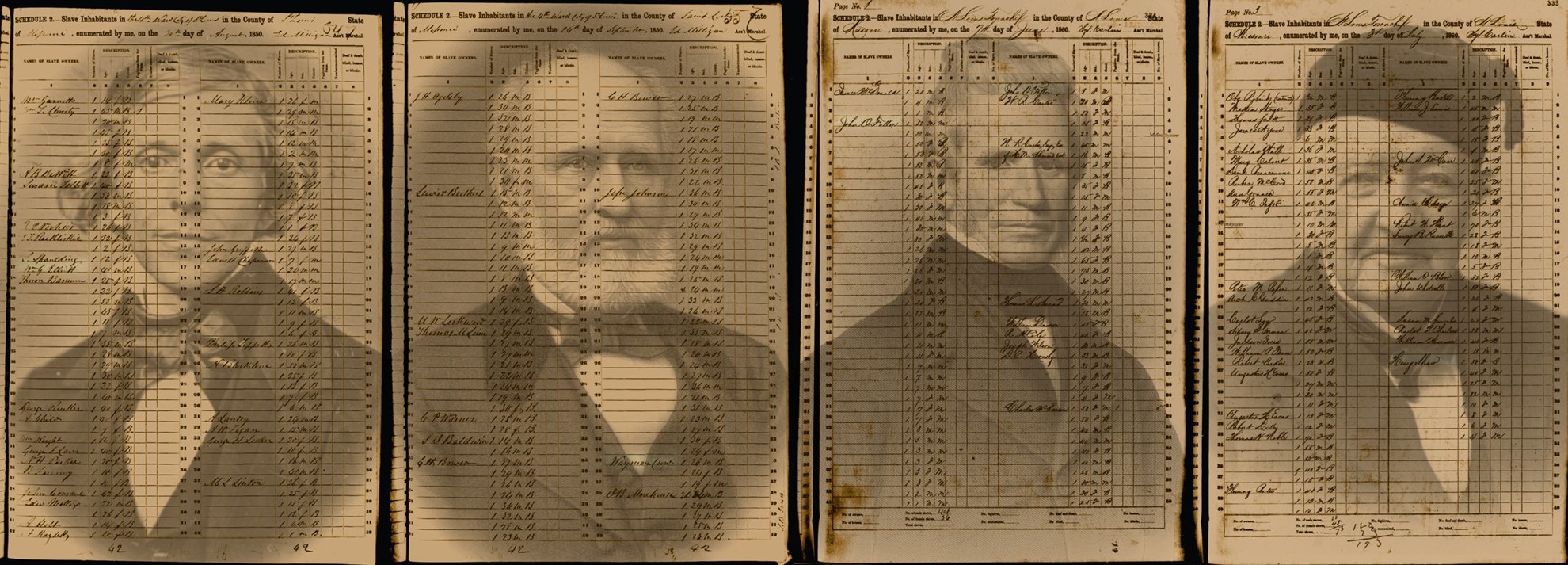
The census describes Shaw to have enslaved:
1. 30-year-old Black male
2. 3-year-old Black male
3. 1-year-old Black male
4. 30-year-old Black male
5. 20-year-old Black male
6. "4/12"-year-old Black female
7. 50-year-old "Mulatto" female
8. 18-year-old "Mulatto" male
9. 15-year-old Black female
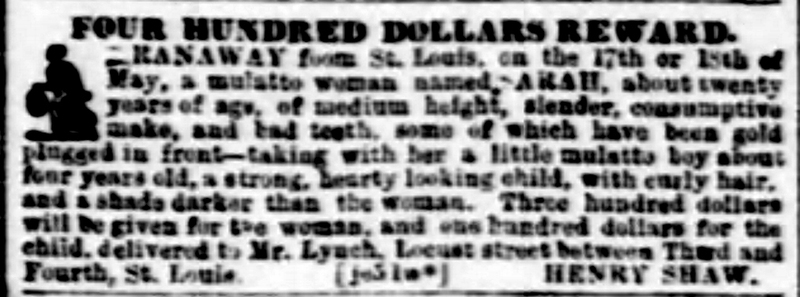
This newspaper advertisement, placed by Henry Shaw, promises a $300 reward for the capture of Sarah and $100 for her son, both of whom Henry Shaw enslaved. Sarah is a "mulatto woman" about twenty years of age, "of medium height, slender, consumptive make, and bad teeth, some of which have been gold plugged in front," and her son is "four years old, a strong, hearty looking child, with curly hair, and a shade darker than the woman."
Robert Johnson served as president of the Association of Black Collegians (ABC) during the pivotal 1968 campus protests. He authored the “Black Manifesto,” a document demanding institutional accountability and the creation of a Black Studies program at Washington University. His leadership during the sit-in helped bring about lasting change, including the establishment of African and African American Studies as a formal academic program.
This document details the legal proceedings of a fugitive enslavement case in St. Louis, Missouri, dated October 21, 1850. Presided over by Judge Alexander Hamilton, the case involves the escape of an enslaved man named Bill, who fled from the enslaver Andrew G. Gist in the spring of 1850. The record provides a description of Bill and certifies his status as an enslaved man under Missouri law, as well as the legal steps taken by Gist to reclaim him under the Fugitive Slave Act of 1850.
Receipt from bounty hunter, Bernard Lynch to Henry Shaw itemizing costs incurred boarding captive enslaved persons, Sarah and Esther. Costs incurred arresting Esther and her subsequent sale to John D. Fondren of Vicksburg for a total of $350. Dated July 30th, 1855
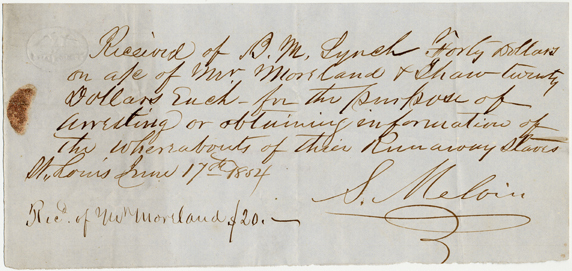
Receipt of payment to bounty hunter, Bernard Lynch, on behalf of Mr. Moreland and Shaw 20 dollar each for information, tracking, and return of their escaped slaves (assumed to be Sarah and her child). Dated June 17th, 1854 and signed by a S. Meloin. The document itself doesn't seem to mention Sarah or her child's name.
Receipt from bounty hunter Benard Lynch for $100 to Henry Shaw itemizing costs incurred capturing enslaved person, Esther in Illinois and returning her to Saint Louis. Dated May 21st, 1855.
This is a purchase receipt for Henry Shaw, paying for the newspaper advertisement of John and Mary Meachum's Trustee's sale of property. The cost was $15.00. The purchase was submitted to the newspaper *St. Louis New Era* Office, to C.G. Ramsey (assumed to be Charles G. Ramsey, the owner of the St. Louis New Era Newspaper) and Geo. Brownfield.
Alphonse Netmore (or Wetmore) is the Justice.
Charles G. Ramsey, a prominent newspaper publisher at the time, provided the affidavit.
The trustee's sale of property to John and Mary Meachum is being published in the newspaper titled 'St. Louis New Era'.
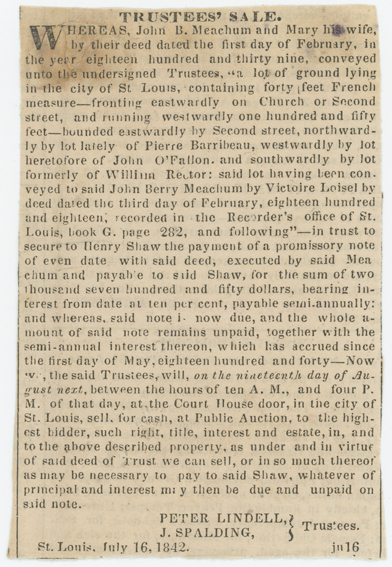
This is a newspaper advertisement of the Trustees' Sale of John and Mary Meachum's property in 1842, due to their inability to pay off the loan from Henry Shaw. The advertisement describes the location of property.
A memorandum dated 1 May 1840 for a two-year extension of the $2750.00 loan agreement between John Berry Meachum and Henry Shaw was issued on 1 February 1839. The memorandum states that Meachum paid the interest on the loan from February 1st, 1839.
Loan agreement for $2750.00 between John Berry Meachum and Henry Shaw, 1 February 1839 with interest. Describes that Shaw received interest of fifteen months in the back.
Letter from Johnson Hellen, enslaver, to William Greenleaf Eliot, which included a stipulation for Virginia’s freedom from enslavement at age twenty-five. Additional note by Eliot states Virginia was emancipated and married William Parks, handyman. Johnson Hellen was from Washington City.
This is a declaration of bankruptcy by John Berry Meachum, dated 10 June 1842. The hearing date is dated 10 September 1842. James Hannon (?) is the clerk; Wm. Milburn (?) is the commissioner; N. M. Garseho (?) is the assignee.
Jesse C. Swanigan was among the first Black undergraduates admitted to Washington University after its 1952 desegregation. Initially a student in the College of Arts and Sciences, he later completed his degree in 1966 through the School of Continuing & Professional Studies. Reflecting on his early experiences, Swanigan described both the excitement of new opportunity and the pressure of representing the entire Black community on campus. His perseverance embodied the complex realities of integration at a university still grappling with its segregated past.
Jim Kennerly was sold to Henry Shaw at an auction held at the St. Louis courthouse on January 1, 1852 when he was about 25-30 years old, as part of the estate of his deceased enslaver Lewellyn Brown. He was part of a group of enslaved people who attempted escape on May 21, 1855, at the site known today as the Mary Meachum Freedom Crossing. They crossed the Mississippi River to Illinois only to find bounty hunters lying in wait to capture them. Jim Kennerly was able to evade capture along with a few others, as there is no record of him being captured and resold. The 1852 bill of sale for Jim written in ink shows a later update written in pencil that states he “ran away May 1855.”