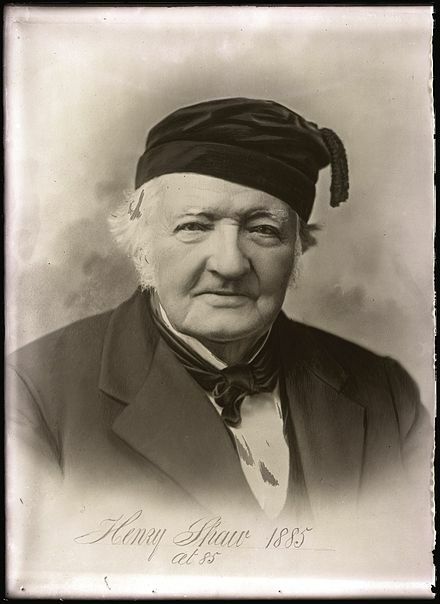
Early trustee and benefactor of WashU, founder of Botany Department; large landowner and slaveholder in 19th-century St. Louis; enslaved more than seventeen people; legacy includes Missouri Botanical Garden and Tower Grove Park.
Hale Giddings Parker was among the first Black students to attend Washington University in St. Louis. An Ohio native and 1873 graduate of Oberlin College, Parker entered the university’s law school in the late 1870s. Although he completed his coursework, he was denied a law degree after reportedly scoring one point below the passing mark on his final exam. Despite this setback, Parker went on to a distinguished legal and civic career across the Midwest. He served as alternate commissioner-at-large for the 1893 World’s Columbian Exposition in Chicago, where he confronted organizers over the exclusion of African American exhibits. In 1916, Parker’s former classmate David Castleman Webb led an effort to secure him an honorary law degree, but Chancellor Frederick Hall refused, further erasing his legacy within the university’s history.
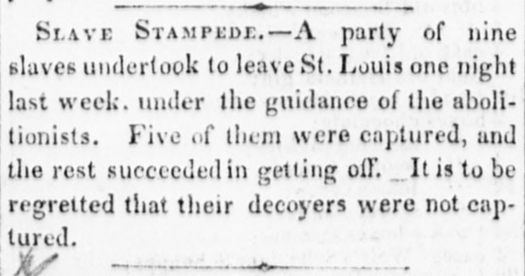
Glasgow Weekly Times describes that nine enslaved people attempted to escape "under the guide of the abolitionists," and that five were captured, but others "succeeded in getting off." The newspaper account also regrettably mentions that the "decoyers" were not captured.
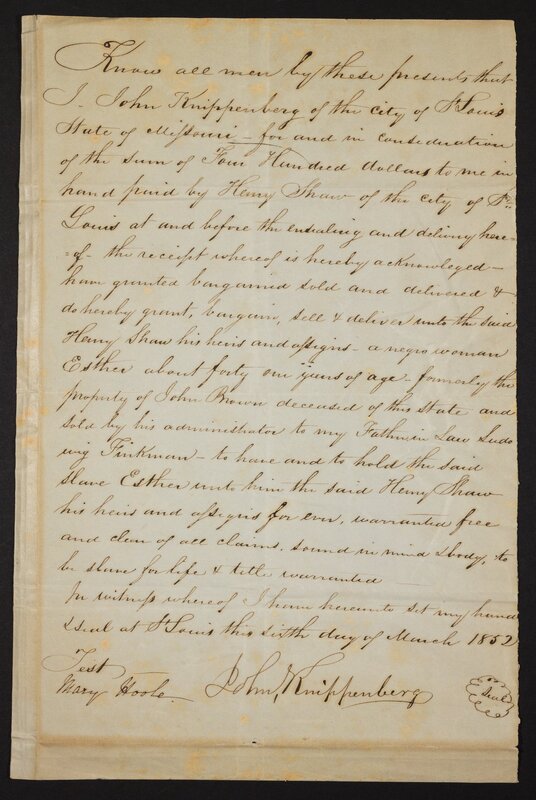
In this StoryMap, student researcher Julia Feller explores the history of self-liberation and St. Louis' Underground Railroad through the heroic and tragic story of Esther. Born into slavery ca. 1811, Esther was one of several people enslaved by WashU benefactor Henry Shaw (founder of the Dept. of Botany), and who fled in search of freedom in 1855.
Elbert A. Walton Jr. was a student at Washington University and a member of the Association of Black Collegians (ABC) during the 1960s. In December 1968, his arrest and alleged beating by campus police over parking violations ignited a major student protest. Forty Black students occupied the campus security office in response, catalyzing one of the most significant demonstrations in WashU’s history. Walton later became an attorney and public official, continuing his advocacy for civil rights and community empowerment.
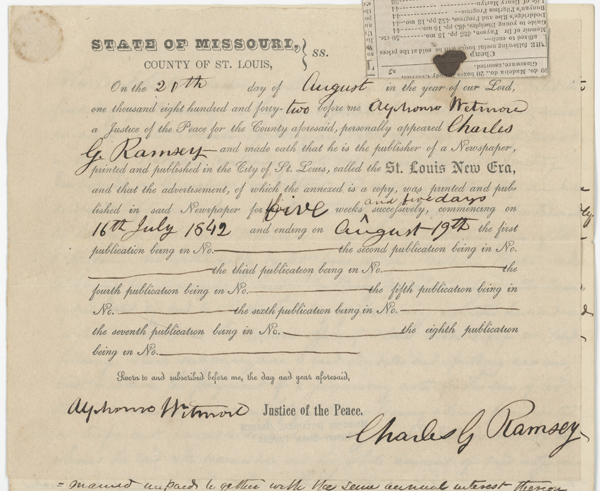
Deed of trust & notice of affidavit of the trustees' sale of property on St. Louis New Era (newspaper). Mentions that the advertisement of the property would be displayed in the newspaper for five weeks and five days, from July 16th, 1842 to August 19th.
This document, dated July 14, 1836, records the manumission of two Black enslaved persons, Julienne and Marguerite, by the enslaver Lambert Jacob in St. Louis, Missouri. Julienne, aged thirty-eight, and her six-year-old daughter, Marguerite, were previously adjudicated to Lambert Jacob as part of the succession of Marie Jean Dardenne in Iberville Parish, Louisiana. Jacob granted their freedom with the condition that they would serve him during his lifetime. The deed was formally acknowledged in the St. Louis Circuit Court, marking the legal release of Julienne and Marguerite from slavery, except for the lifetime service clause imposed by Jacob.
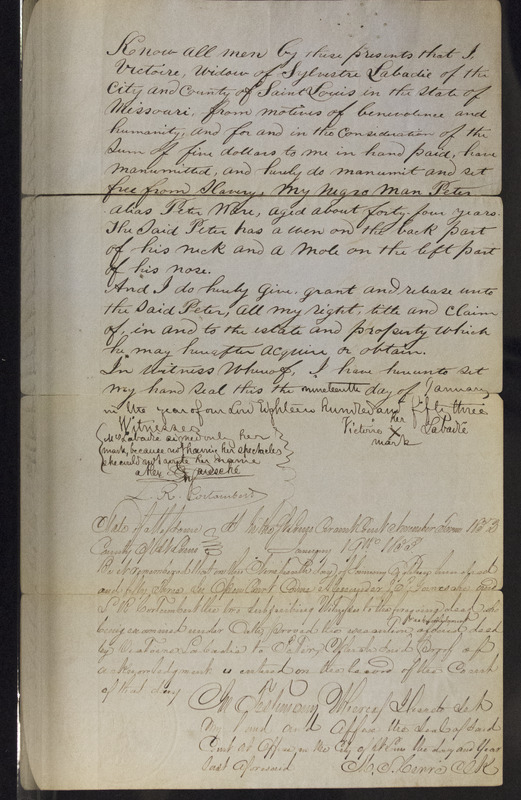
Deed of Emancipation for Peter Ware by Victoire Labadie, widow of Sylvestre Labadie, St. Louis, Missouri, January 19, 1853. Victoire Labadie formally emancipated Peter, a Black man aged about forty-four years, marking him free from enslavement. The document describes Peter's physical features, including a mark on the back of his neck and a mole on the left side of his nose.
Deed of Emancipation for Eliza, a Black woman approximately twenty-nine years old, by John Cavender, St. Louis, Missouri, November 17, 1845. The deed, acknowledged in the St. Louis Circuit Court, formally grants Eliza her freedom, releasing her from all servitude to Cavender and his heirs. Eliza, who is described as being about five feet four or five inches tall, was purchased by Cavender in 1838 from the enslaver William Baf.
This is a copy of the Daily Dispatch on 1855-05-29 that describes the escape of five enslaved people in Alton, Illinois, which presumably points to Mary Meachum's attempted escape of nine enslaved people across the Mississippi River, among whom five were captured.
Crittenden E. Clark was one of the earliest Black graduates of Washington University School of Law, earning his degree in 1897 as the only African American in his class. His achievement reflected both the possibilities and limits of inclusion at the university during this period. Clark went on to a distinguished legal and political career in St. Louis, becoming one of the few Black attorneys in the city with a WashU law degree and an active figure in local Republican Party politics. In 1922, he became the first African American elected justice of the peace in Missouri, and later, at the age of seventy-five, served as an associate city counselor. A longtime resident of the Mill Creek neighborhood, where he lived for four decades, Clark was widely respected as a civic leader, and his success underscores both the rarity and significance of Black legal achievement in the late nineteenth century.
A bond of indemnity presented to Eliot by John A Kassin/Kasson stating that Eliot paid Kassin/Kasson $600.00 to purchase Lydia, an enslaved woman, in order to set her free.
Bill of sale for the purchase of enslaved person Sarah and her infant child by Henry Shaw for the sum of 500 dollars. As the Probate Court of St. Louis on 1850-09-07, aid order Marshall Brotherton administrator of Eliza Brown declared.
This is a bill of sale for the purchase of an enslaved person named Jim by Henry Shaw. Henry Shaw purchased from the previous enslaver of Jim, now deceased, John J. Brown. Shaw bid $1010, which, being the highest, allowed him to purchase the enslaved person Jim. Marshall Brotherton(?) acted as the administrator. This ruling was made in the December Term 1851 of the Probate Court of the County of St. Louis, State of Missouri.
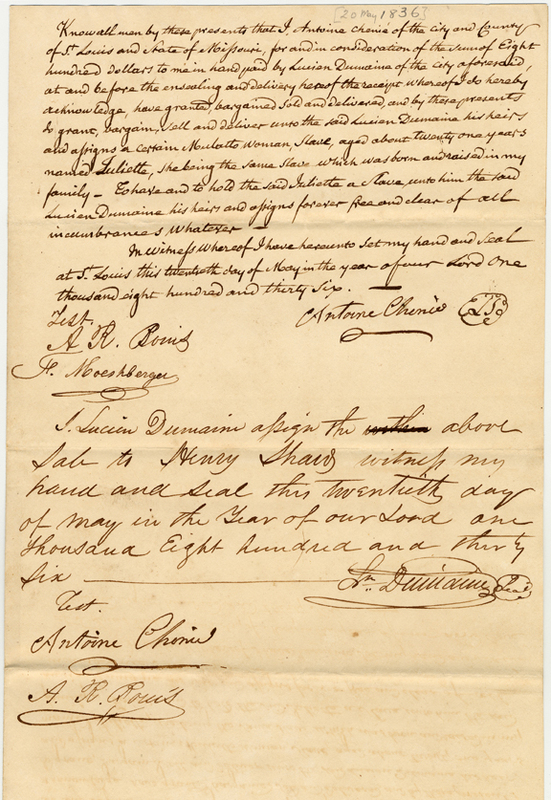
This is the bill of sale of Juliette, previously enslaved by Antoine Chenie, to Henry Shaw at the cost of eight hundred and thirty six dollars. This is dated May 20th, 1836 and manumitted April 24th, 1839.
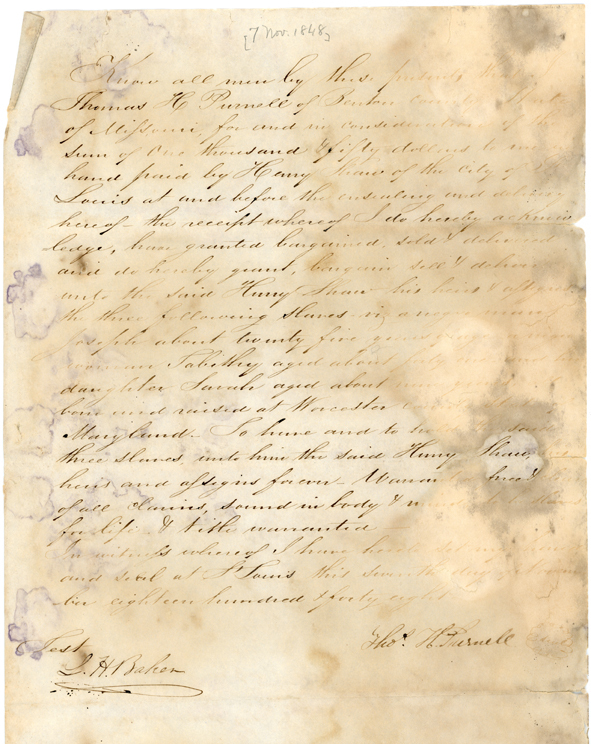
Bill of sale for purchase of enslaved persons Joseph, Tabitha, and her daughter Sarah by Henry Shaw in 1848. For the price of 1050 dollars, they were sold by Thomas H. Purnell to Henry Shaw.
Augustus O. Thornton was one of the few Black students admitted to Washington University’s Manual Training School in the late 19th century. Graduating in 1892 alongside Eugene Hutt, Thornton was known for his academic diligence and leadership. After graduation, he became a public school teacher and later dean of boys at Sumner High School, the first high school for African Americans west of the Mississippi River. His career reflected the limited but vital educational and professional pathways open to Black educators in the segregated school systems of the era.
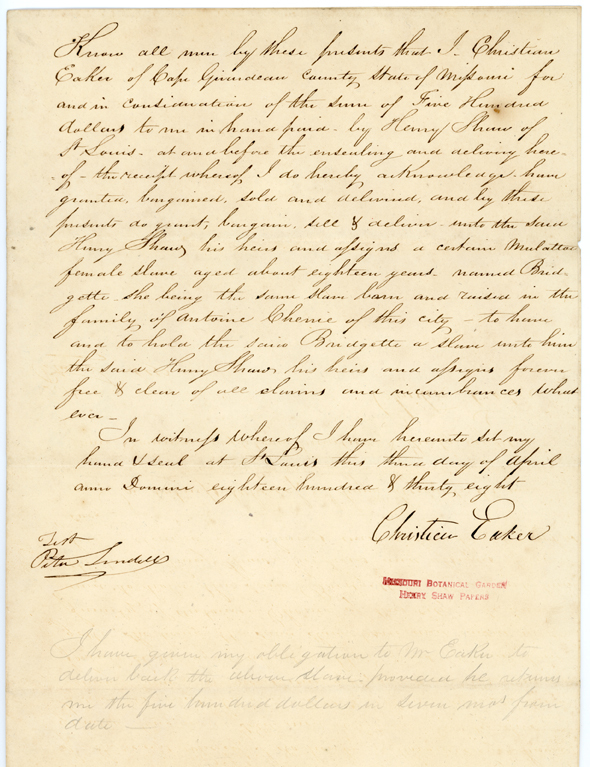
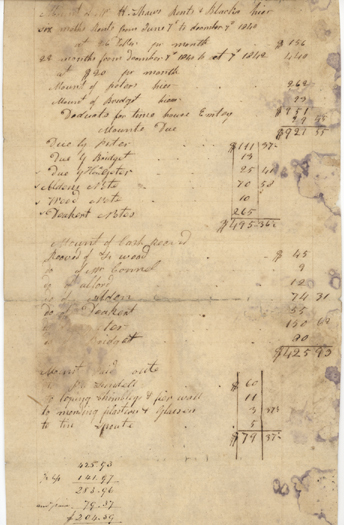
The document details:
6 months of 26 dollar per month for rent,
22 months of 20 dollar per month for unnamed expense,
"Mount of Peter's hier" - $262,
"Mount of Bridget's hiear" - $93
Deducts per time hours entry
Due by Peter - $111
Due by Bridget -$13
Due by Hour Peter - $25
Mount of Last Review
...
To Peter - $150
To Bridget - $20
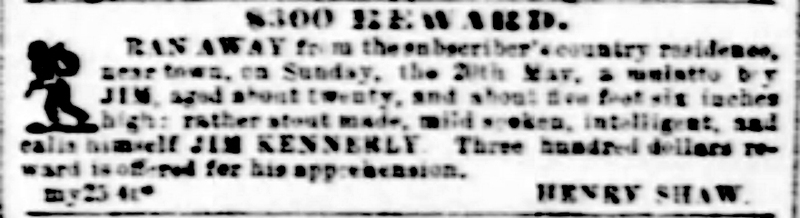
On May 25, 1855, the Missouri Republican published an advertisement issued by Henry Shaw, offering a $300 reward for the return of Jim, an enslaved person owned by Shaw who had apparently escaped on May 20, 1855. The newspaper contains physical descriptions of Jim.
A memorandum was issued on 1 May 1840 for a two-year extension of the loan agreement initially settled on 1 February 1839 between John Berry Meachum and Henry Shaw.
This newspaper ad was published in the Missouri Republican on May 25, 1855. Henry Shaw places a $300 reward for Jim, who, according to the ad, calls himself Jim Kennerly, who was enslaved by Shaw but escaped.
Jim is described to have aged about twenty as of 1855, about five(?) feet six inches tall: rather stout made, mild spoken, intelligent, and called himself Jim Kennerly.