Deed of trust & notice of affidavit of the trustees' sale of property on St. Louis New Era (newspaper). Mentions that the advertisement of the property would be displayed in the newspaper for five weeks and five days, from July 16th, 1842 to August 19th.
This document, dated July 14, 1836, records the manumission of two Black enslaved persons, Julienne and Marguerite, by the enslaver Lambert Jacob in St. Louis, Missouri. Julienne, aged thirty-eight, and her six-year-old daughter, Marguerite, were previously adjudicated to Lambert Jacob as part of the succession of Marie Jean Dardenne in Iberville Parish, Louisiana. Jacob granted their freedom with the condition that they would serve him during his lifetime. The deed was formally acknowledged in the St. Louis Circuit Court, marking the legal release of Julienne and Marguerite from slavery, except for the lifetime service clause imposed by Jacob.
This document, dated December 3, 1845, records the emancipation of Samuel, a 38-year-old Black man, by Louis A. LaBeaume, Theodore LaBeaume, Louis T. LaBeaume, Edmund LaBeaume, Laura LaBeaume, and Peter E. Blow—enslavers in St. Louis, Missouri. The deed officially grants Samuel his freedom, declaring him manumitted and released from all servitude to the LaBeaume family and their heirs. The document also mentions a nominal payment of one dollar, symbolizing the legal transaction.
Deed of Emancipation for Peter Ware by Victoire Labadie, widow of Sylvestre Labadie, St. Louis, Missouri, January 19, 1853. Victoire Labadie formally emancipated Peter, a Black man aged about forty-four years, marking him free from enslavement. The document describes Peter's physical features, including a mark on the back of his neck and a mole on the left side of his nose.
Deed of Emancipation for Eliza, a Black woman approximately twenty-nine years old, by John Cavender, St. Louis, Missouri, November 17, 1845. The deed, acknowledged in the St. Louis Circuit Court, formally grants Eliza her freedom, releasing her from all servitude to Cavender and his heirs. Eliza, who is described as being about five feet four or five inches tall, was purchased by Cavender in 1838 from the enslaver William Baf.
This is a copy of the Daily Dispatch on 1855-05-29 that describes the escape of five enslaved people in Alton, Illinois, which presumably points to Mary Meachum's attempted escape of nine enslaved people across the Mississippi River, among whom five were captured.
A bond of indemnity presented to Eliot by John A Kassin/Kasson stating that Eliot paid Kassin/Kasson $600.00 to purchase Lydia, an enslaved woman, in order to set her free.
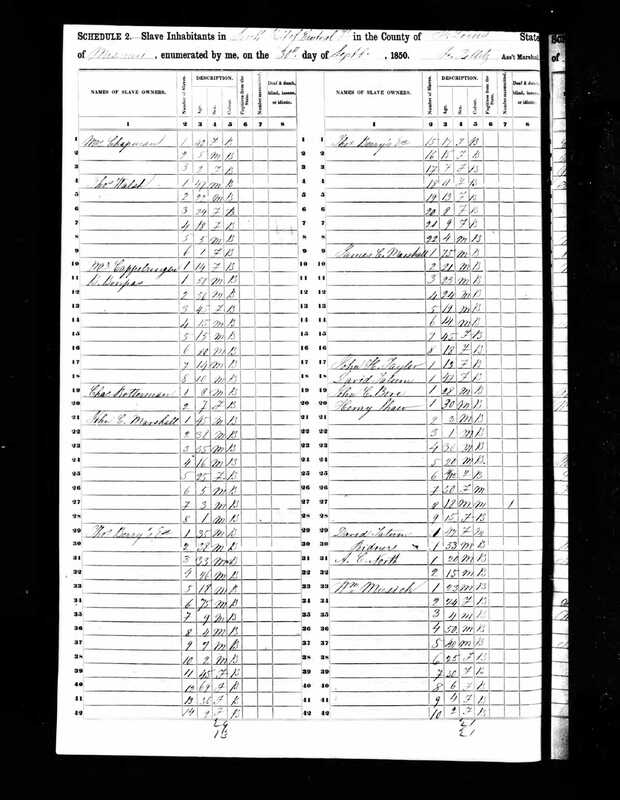
Bill of sale for the purchase of enslaved person Sarah and her infant child by Henry Shaw for the sum of 500 dollars. As the Probate Court of St. Louis on 1850-09-07, aid order Marshall Brotherton administrator of Eliza Brown declared.
This is a bill of sale for the purchase of an enslaved person named Jim by Henry Shaw. Henry Shaw purchased from the previous enslaver of Jim, now deceased, John J. Brown. Shaw bid $1010, which, being the highest, allowed him to purchase the enslaved person Jim. Marshall Brotherton(?) acted as the administrator. This ruling was made in the December Term 1851 of the Probate Court of the County of St. Louis, State of Missouri.
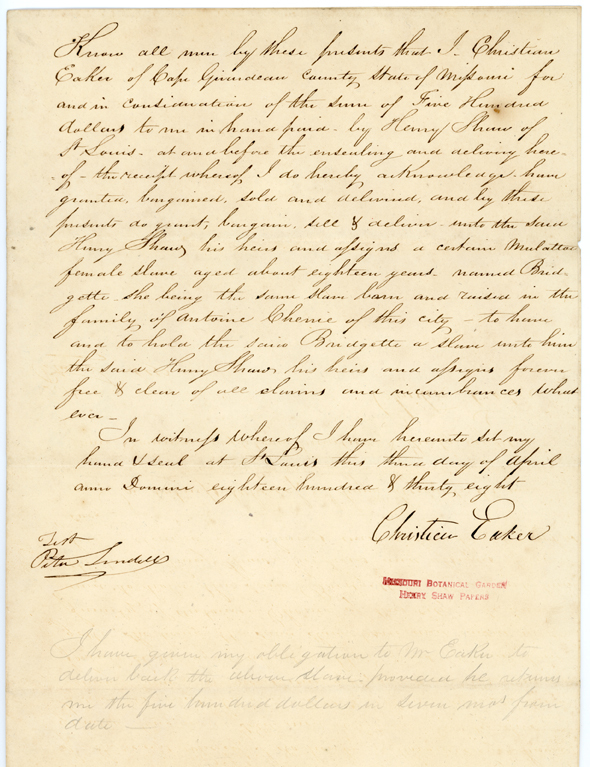
This is the bill of sale of Juliette, previously enslaved by Antoine Chenie, to Henry Shaw at the cost of eight hundred and thirty six dollars. This is dated May 20th, 1836 and manumitted April 24th, 1839.
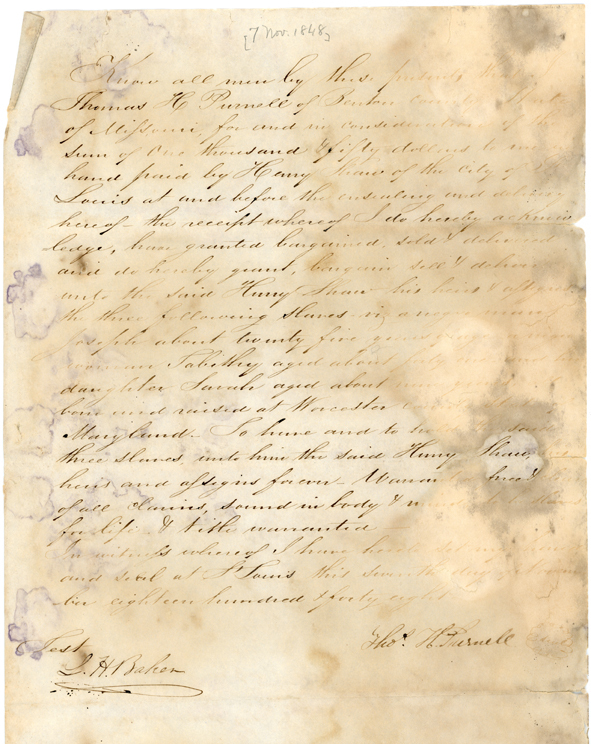
Bill of sale for purchase of enslaved persons Joseph, Tabitha, and her daughter Sarah by Henry Shaw in 1848. For the price of 1050 dollars, they were sold by Thomas H. Purnell to Henry Shaw.