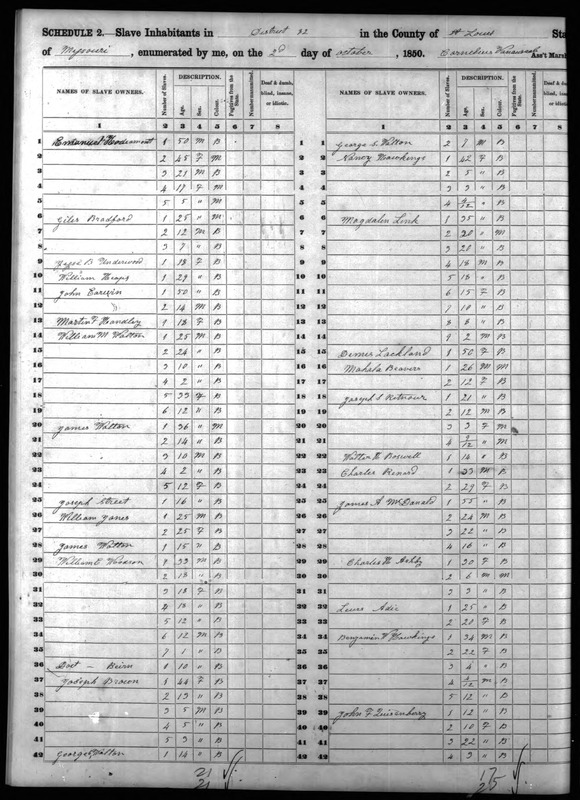
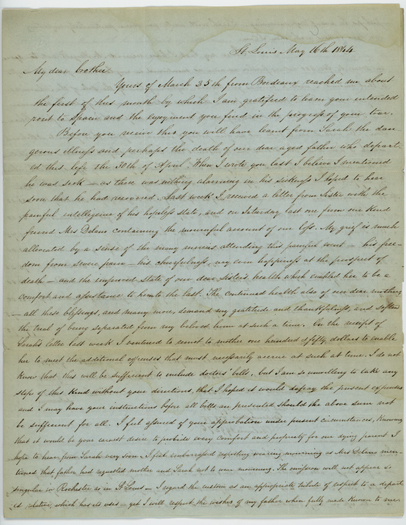
This is the 1850 Census of Martin F. Hanley, and in it is listed that he has one slave. Presumably that is Lydia Jackson who is mentioned in the other Hanley House papers. She is 18 at the time of this census and is labeled as Black.
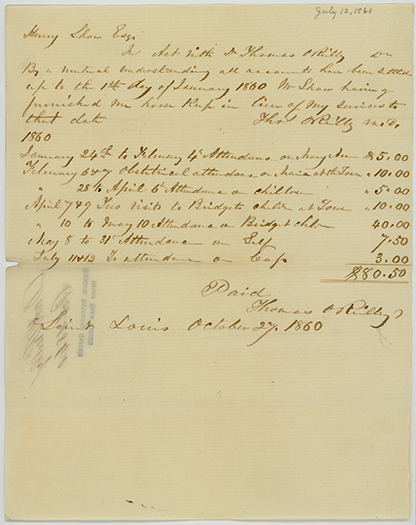
Maria was enslaved by Henry Shaw according to a bill with Dr. Thomas O’Reilly for obstetrical attendance on February 6 and 7, 1860 at Tower Grove, which indicates that Maria was pregnant. and—if she survived—may have had a child.
Loan agreement for $2750.00 between John Berry Meachum and Henry Shaw, 1 February 1839 with interest. Describes that Shaw received interest of fifteen months in the back.
Letter from Johnson Hellen, enslaver, to William Greenleaf Eliot, which included a stipulation for Virginia’s freedom from enslavement at age twenty-five. Additional note by Eliot states Virginia was emancipated and married William Parks, handyman. Johnson Hellen was from Washington City.
Larkin Williams and his brother Hamilton Williams both owned land on the southern side of what would become Tyson Research Center. They were part of the large Williams family that had a significant presence in Missouri during the early 1800s. This family was also known to have sympathy toward the Confederates during the Civil War and were likely enslavers.
Juliette was born and raised in the family of Antoine Chenie, who sold her, through Lucien Dumaine, to Henry Shaw on May 20, 1836, when she was about twenty-one years old. Juliette remained enslaved until she obtained freedom from Shaw at about the age of 23 on April 24, 1839.
John Richard Barrett (b. 1825) is listed as a landowner in 1852 plat maps of the region that is now Tyson Research Center; he and his uncle, Richard, bought and sold various parcels of land in what is now Tyson and the surrounding environs during the decade leading up to the Civil War. Barrett was a prominent member of the St. Louis community at the time and was elected to Missouri state legislature in 1852. Barrett supported the Missouri Pacific Railroad, which broke ground in 1851 and eventually laid track north of the Meramec River and near Barrett properties in and around Tyson. Purchasing land in the area may have been a family effort to speculate on land value increases due to the construction of the Missouri Pacific railroad line. Barrett’s station, just east of Tyson across the Meramec on the Missouri Pacific line, is named for J.R. Barrett. According to the Kirkwood Historical Society, “J. R. Barret ... owned 236 acres on the west side of Barrett Station Road. He purchased this land in 1851. Three months after purchase, he signed a deed with the Pacific Railroad allowing the railroad to have the rights across his land for $5.00 while keeping the timber rights. He lost this land in 1865 when it was sold on the courthouse steps due to his default on the loan.”1
While he supported the protection of slavery in states where it already existed, he opposed the expansion of slavery in new states and territories. Barrett, his mother, and his uncle were all enslavers. J.R. Barrett is listed as enslaving and leasing six people in the 1860 federal census. He stood as security for Louis, Oscar Early, and John Evans when they applied for freedom licenses in 1853, 1860, and 1861, respectively.
John Franklin Kerr (1832-1902), born to Thomas Gordon Kerr and Margaret Johnston Calbreadth, owned property in 1838 within present-day Tyson. Kerr's father died when he was two years old, and likely left the land in John's name. Kerr married Martha Green in 1853 and they had at least one son, David G. Kerr.
The Kerr family were enslavers. In the 1830 Census, St. Louis Middle Ward, they were listed as enslaving a girl and a boy between the age of 10-23, and a man between the age of 24-35.
John David Coalter (d. 1864) owned land that later became part of Tyson Research Center according to plat maps from 1862, 1870, and 1878. Coalter was a politician and lawyer. He was elected as a representative for St. Charles County to the Missouri State Legislature in 1836, 1838 and 1844. He was a delegate to the Missouri Constitutional Convention in 1845.
On July 11, 1864, John D. Coalter emancipated Lucy Ann White, the daughter of a couple enslaved by his late wife’s parents, John and Mary Means. Coalter's will emancipated Benjamin White after his death on October 19, 1864.
John Breckenridge Wells (1800-1890) was born in Kentucky and moved to Missouri in 1833. He owned land that is today part of Tyson Research Center according to a plat map of 1838, the same year that an enslaved woman named Virginia obtained her freedom from him.