Enoch Holcomb (1799 – 1852) owned property within what is now Tyson Research Center according to plat maps from 1838 and 1846. No records have yet been found indicating that Holcomb or members of his family were enslavers.
Elizabeth L. Hart Coats (1812-1859) received land from her father, Henry C. Hart, which the U.S. government granted to him for his military service in the War of 1812. Elizabeth Hart settled in Missouri and married James Coats.
The Harts were enslavers. In 1855, Henry C. Hart and Elizabeth L. Hart emancipated Susan, a 25-year-old woman described as married to George Kibby on December 4, 1855. It is possible, but not confirmed, that a Henry Hart in the 1840 St. Louis census who enslaved one young woman was the same Henry C. Hart. According to the 1860 Census, H. Clay Hart enslaved 14 people in Carondelet: three women ages 60, 30, and 22, four men ages 35, 32, 24, and 21, a 17-year-old youth, four boys ages 13, 10, 6, and 4, and two girls ages 3 and six months.
Elias Browne Cockey (1800 –1838) held land on what is now Tyson Research Center property according to an 1838 plat map. Cockey was killed the same year by James H. Dougherty, with whom he had a contract to deliver 1,000 saw logs. After Cockey’s death, James, a man he enslaved, was sold at auction.
Elbert A. Walton Jr. was a student at Washington University and a member of the Association of Black Collegians (ABC) during the 1960s. In December 1968, his arrest and alleged beating by campus police over parking violations ignited a major student protest. Forty Black students occupied the campus security office in response, catalyzing one of the most significant demonstrations in WashU’s history. Walton later became an attorney and public official, continuing his advocacy for civil rights and community empowerment.
Edward Buckingham was born in 1814 to Gideon Buckingham and Maria Crowley. He married Emma Marlow in 1845. Buckingham appears as a landowner on what is now Tyson property in 1862 and 1870. His daughter, Isabel (Belle) Buckingham Simpson, inherited land from her father.
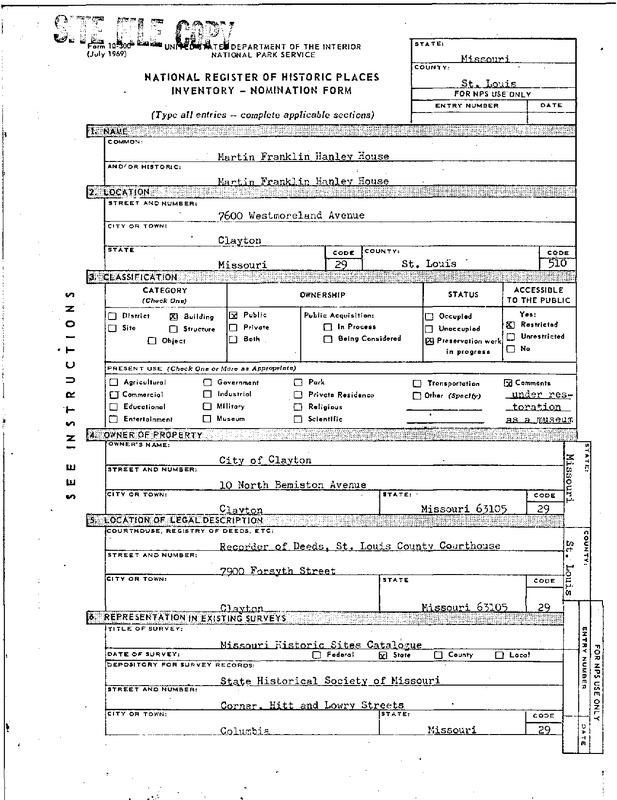
This register documents Hanley House as " one ofthe only ordinary Missouri houses of its style and period to have survived" and that it is worth preservation. The register also notes that the Hanley family were slaveholders.
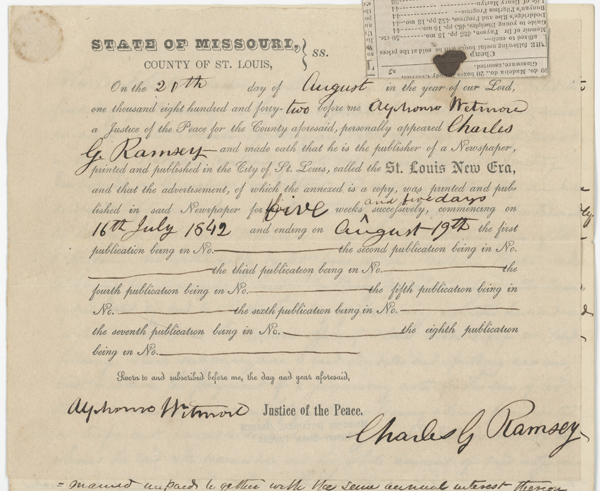
Deed of trust & notice of affidavit of the trustees' sale of property on St. Louis New Era (newspaper). Mentions that the advertisement of the property would be displayed in the newspaper for five weeks and five days, from July 16th, 1842 to August 19th.
This document, dated July 14, 1836, records the manumission of two Black enslaved persons, Julienne and Marguerite, by the enslaver Lambert Jacob in St. Louis, Missouri. Julienne, aged thirty-eight, and her six-year-old daughter, Marguerite, were previously adjudicated to Lambert Jacob as part of the succession of Marie Jean Dardenne in Iberville Parish, Louisiana. Jacob granted their freedom with the condition that they would serve him during his lifetime. The deed was formally acknowledged in the St. Louis Circuit Court, marking the legal release of Julienne and Marguerite from slavery, except for the lifetime service clause imposed by Jacob.
This document, dated December 3, 1845, records the emancipation of Samuel, a 38-year-old Black man, by Louis A. LaBeaume, Theodore LaBeaume, Louis T. LaBeaume, Edmund LaBeaume, Laura LaBeaume, and Peter E. Blow—enslavers in St. Louis, Missouri. The deed officially grants Samuel his freedom, declaring him manumitted and released from all servitude to the LaBeaume family and their heirs. The document also mentions a nominal payment of one dollar, symbolizing the legal transaction.
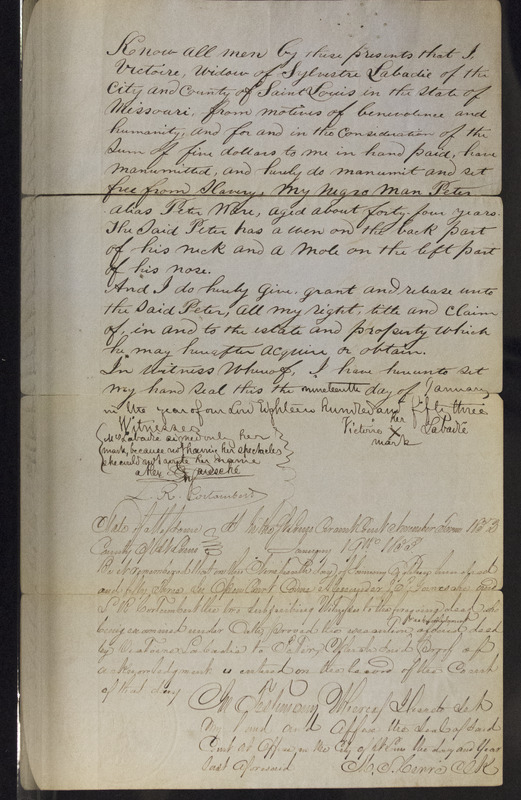
Deed of Emancipation for Peter Ware by Victoire Labadie, widow of Sylvestre Labadie, St. Louis, Missouri, January 19, 1853. Victoire Labadie formally emancipated Peter, a Black man aged about forty-four years, marking him free from enslavement. The document describes Peter's physical features, including a mark on the back of his neck and a mole on the left side of his nose.
Deed of Emancipation for Eliza, a Black woman approximately twenty-nine years old, by John Cavender, St. Louis, Missouri, November 17, 1845. The deed, acknowledged in the St. Louis Circuit Court, formally grants Eliza her freedom, releasing her from all servitude to Cavender and his heirs. Eliza, who is described as being about five feet four or five inches tall, was purchased by Cavender in 1838 from the enslaver William Baf.
This is a copy of the Daily Dispatch on 1855-05-29 that describes the escape of five enslaved people in Alton, Illinois, which presumably points to Mary Meachum's attempted escape of nine enslaved people across the Mississippi River, among whom five were captured.
William Waton would have been Cyrene's grandfather who moved to St. Louis with his parents in 1792, there is report that the family brought 110 enslaved people with them from Missouri.
Crittenden E. Clark was one of the earliest Black graduates of Washington University School of Law, earning his degree in 1897 as the only African American in his class. His achievement reflected both the possibilities and limits of inclusion at the university during this period. Clark went on to a distinguished legal and political career in St. Louis, becoming one of the few Black attorneys in the city with a WashU law degree and an active figure in local Republican Party politics. In 1922, he became the first African American elected justice of the peace in Missouri, and later, at the age of seventy-five, served as an associate city counselor. A longtime resident of the Mill Creek neighborhood, where he lived for four decades, Clark was widely respected as a civic leader, and his success underscores both the rarity and significance of Black legal achievement in the late nineteenth century.
Christopher Cockrill (1818 – 1873), born in Fayette, Virginia, moved with his parents and family to Missouri in the 1820s. His father, Starks S. Cockrill, Sr., obtained land grants on what is now Tyson Research Center Property, and in 1830, the Cockrill family held three people in slavery in Bonhomme Township. By the recording of the 1850 census, Starks S. Cockrill Sr., Starks Cockrill Jr., and Christopher Cockrill had all established separate households next to one another and worked as farmers. While the families of Starks Cockrill Sr. and Jr. moved to Texas by 1860, Christopher Cockrill continued to live in Bonhomme Township, where he enslaved five people according to the 1860 census and held land on what is now Tyson property according to an 1870 plat map.
The Cockrills were enslavers. The 1830 Census for Bonhomme Township lists two girls and a boy aged between 10-23 as enslaved by Starks Cockrill, Sr. In the 1850, he enslaved three men aged between 22-35, four boys aged between 4-10, a 30-year old woman and a 2-year old girl in Bonhomme Township. In 1860, Christopher Cockrill enslaved a 30-year old man, a 25-year old woman, and three boys aged 1, 6 and 11 in Bonhomme Township.
Like many men of European heritage in nineteenth century St. Louis, Christian Morschel (1834-1901) involved himself with several business ventures to expand his wealth. Morschel specialized in the mining industry. He may have been interested in the land along the Meramec for the purpose of sand and gravel mining. By 1870 he was living in Bonhomme Township with his family and co-owned land with Philip Kais in what is today Tyson Research Center that bordered a stretch of the Meramec according to 1878 and 1893 plat maps. Although records indicate that Morschell died in 1901, a 1909 plat map names Morschell owning land with J. B. Hollman.
A bond of indemnity presented to Eliot by John A Kassin/Kasson stating that Eliot paid Kassin/Kasson $600.00 to purchase Lydia, an enslaved woman, in order to set her free.
Bill of sale for the purchase of enslaved person Sarah and her infant child by Henry Shaw for the sum of 500 dollars. As the Probate Court of St. Louis on 1850-09-07, aid order Marshall Brotherton administrator of Eliza Brown declared.
This is a bill of sale for the purchase of an enslaved person named Jim by Henry Shaw. Henry Shaw purchased from the previous enslaver of Jim, now deceased, John J. Brown. Shaw bid $1010, which, being the highest, allowed him to purchase the enslaved person Jim. Marshall Brotherton(?) acted as the administrator. This ruling was made in the December Term 1851 of the Probate Court of the County of St. Louis, State of Missouri.