Browse Records
-
W.G.E. to General ShermanWilliam tells the story of how he became the guardian of a child, Lily, whose mother Barbara was a "colored woman." When Lily’s mother, Barbara, died, Lily was given to Judy, Archer Alexander’s wife, to care for. But when Judy died, Archer asked William to care for Lily, which he did. Then William learned that Lily had an older sister, Lizzie, who was in the care of Colonel John Balfour. Colonel Balfour asked William to become legal guardians for both girls, which he did. Colonel Balfour gave William US Bonds to help pay for the girls’ care. William is asking General Sherman to ask his brother John Sherman, Secretary of the Treasury, to help get the money from the bonds so he can use it for care of the girls. William also states that Archer Alexander has been in his service since 1863 when he gave him protection under authority of Provost Marshall. He also says Archer Alexander was the “original of the kneeling slave in the Lincoln Emancipation group by Thomas Ball.” William Greenleaf Eliot to Gen. Sherman.
-
 Bond of Indemnity for LydiaA bond of indemnity presented to Eliot by John A Kassin/Kasson stating that Eliot paid Kassin/Kasson $600.00 to purchase Lydia, an enslaved woman, in order to set her free.
 -
 Letter acknowledging receipt of Virginia, enslaved girlLetter from Johnson Hellen, enslaver, to William Greenleaf Eliot, which included a stipulation for Virginia’s freedom from enslavement at age twenty-five. Additional note by Eliot states Virginia was emancipated and married William Parks, handyman. Johnson Hellen was from Washington City.
-
 Deed of Manumission for Julienne and Marguerite by Lambert Jacob - July 14, 1836This document, dated July 14, 1836, records the manumission of two Black enslaved persons, Julienne and Marguerite, by the enslaver Lambert Jacob in St. Louis, Missouri. Julienne, aged thirty-eight, and her six-year-old daughter, Marguerite, were previously adjudicated to Lambert Jacob as part of the succession of Marie Jean Dardenne in Iberville Parish, Louisiana. Jacob granted their freedom with the condition that they would serve him during his lifetime. The deed was formally acknowledged in the St. Louis Circuit Court, marking the legal release of Julienne and Marguerite from slavery, except for the lifetime service clause imposed by Jacob.
 -
 Deed of Emancipation for Samuel by Louis A. LaBeaume and Others - December 3, 1845This document, dated December 3, 1845, records the emancipation of Samuel, a 38-year-old Black man, by Louis A. LaBeaume, Theodore LaBeaume, Louis T. LaBeaume, Edmund LaBeaume, Laura LaBeaume, and Peter E. Blow—enslavers in St. Louis, Missouri. The deed officially grants Samuel his freedom, declaring him manumitted and released from all servitude to the LaBeaume family and their heirs. The document also mentions a nominal payment of one dollar, symbolizing the legal transaction.
 -
 Deed of Emancipation for Eliza by John Cavender, November 17, 1845Deed of Emancipation for Eliza, a Black woman approximately twenty-nine years old, by John Cavender, St. Louis, Missouri, November 17, 1845. The deed, acknowledged in the St. Louis Circuit Court, formally grants Eliza her freedom, releasing her from all servitude to Cavender and his heirs. Eliza, who is described as being about five feet four or five inches tall, was purchased by Cavender in 1838 from the enslaver William Baf.
 -
 Record of escape - Bill, enslaved man - St. Louis, Missouri - October 21, 1850This document details the legal proceedings of a fugitive enslavement case in St. Louis, Missouri, dated October 21, 1850. Presided over by Judge Alexander Hamilton, the case involves the escape of an enslaved man named Bill, who fled from the enslaver Andrew G. Gist in the spring of 1850. The record provides a description of Bill and certifies his status as an enslaved man under Missouri law, as well as the legal steps taken by Gist to reclaim him under the Fugitive Slave Act of 1850.
 -
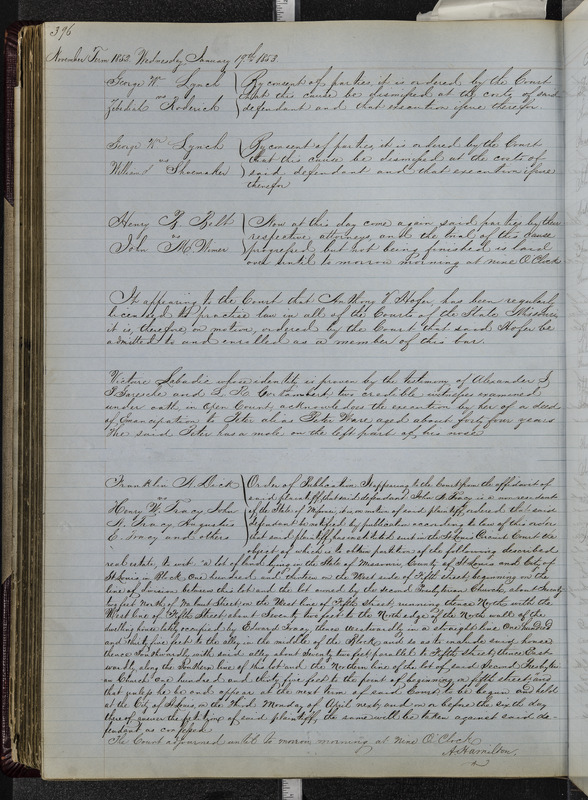
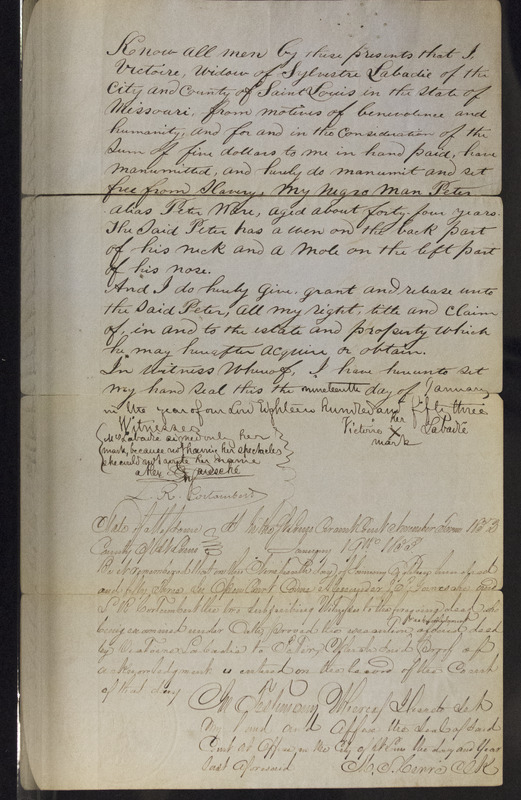 Deed of Emancipation for Peter Ware, enslaved man, January 19, 1853Deed of Emancipation for Peter Ware by Victoire Labadie, widow of Sylvestre Labadie, St. Louis, Missouri, January 19, 1853. Victoire Labadie formally emancipated Peter, a Black man aged about forty-four years, marking him free from enslavement. The document describes Peter's physical features, including a mark on the back of his neck and a mole on the left side of his nose.
-
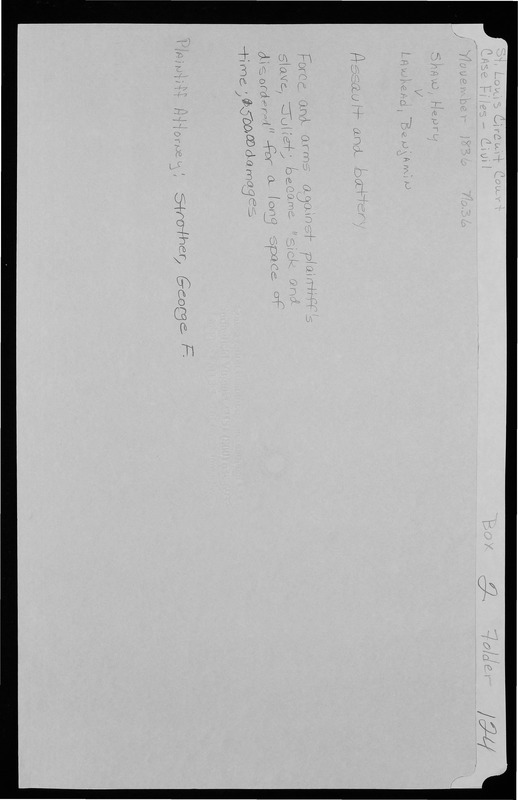 Henry Shaw v. Benjamin Lawhead - Assault and batteryForce and arms against plaintiff's slave, Juliet, became "sick and disorderly" for a long space of time; paid $500 for damages
 -
 St. Louis Circuit Court Record Book 25Record of Emancipation of Mannette and her children.
 -
-
 [Manette]Emancipation record for Manette and her children Lizzy and Theresa, registered in the St. Louis Circuit Court Saturday, April 26, 1856.