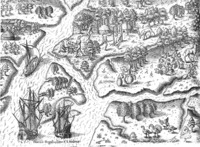
Terra Incognita
Item set
- Title
- Terra Incognita
Items
-
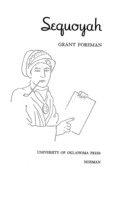 Sequoyah was a Cherokee who lived in Tennessee in the early 1800's. In 1809 he began to create a system of writing for the Cherokee language. It was a syllabary, or written characters which are used to represent a syllable. He invented 86 characters that represented sounds, which made up words. This system was quickly adopted by the Cherokee people and became a valuable way to communicate between settlements that were separated by long distances
 -
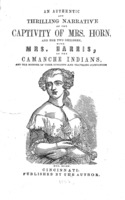 This is a captivity narrative among the Comanche Indians of Ohio.
 -
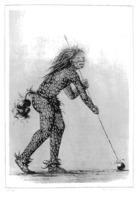 Catlin visited the Mandan in 1832. His month-long, in-depth ethnographic study of the Mandans and their O-kee-pa ceremony is particularly valuable as only a few years after his visit in 1838 the group was decimated by a smallpox epidemic. Only 40 members of the group survived the disease and they were either enslaved, murdered or assimilated into other groups. Catlin was permitted to witness and document the O-kee-pa ceremony which took place over several days and involved dancing and singing of the whole group and a more extreme ceremony of fasting, sleep deprivation and pain for the young men of the tribe. This part of the ceremony was not very well understood by observers of the time and seemed to involve a belief that life or the world needed sacrifices to continue. The sacrifice in this case was the ordeal the young men went through. Their flesh was pierced with splints and then the splints attached to cords, which were suspended from the roof of the lodge. They were to stay suspended as long as they could with weights attached to their feet until they fainted, "and chose to remain there until the Great Spirit gave them strength to get up and walk away." Some of the practices of this dance are similar to the Sun Dance, which was practiced by the Sioux and other groups in the West. Shown here is a dancer in the character of O-ke-hee-de, the owl or Evil Spirit.
 -
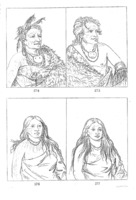 Written during eight years' travel amongst the wildest tribes of Indians in North America. In 1832, 33, 34, 35, 36, 37, 38, and 39. George Catlin began his career in law but had always wanted to be a painter and when he decided to pursue this said he wanted "to become the historian and limner of the aborigines of the vast continent of North America." In the spring of 1830 he set off for St. Louis in order to pursue this. General William Clark, the famed explorer, offered aid and contacts to Catlin. He then spent several years documenting various tribes. His work is notable for its scope and ethnographic detail. This is a copy of the first edition of the two-volume set.
 -
 Travels to the source of the Missouri river and across the American continent to the Pacific Ocean. Performed by order of the government of the United States, in the years 1804, 1805, and 1806. By Captains Lewis and Clarke. Published from the official report, and illustrated by a map of the route, and official report, and illustrated by a map of the route, and other maps. A new ed
 -
 A particular account of his escape, accompanied by an Indian female; the extraordinary hardships they encountered in their flight; and their safe arrival in London, December the 6th, 1799. Written by himself. This is a second edition of a captivity narrative that is probably fictitious.
 -
-
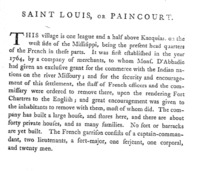 As more people began settling in America and coming more in contact with Native Americans a new genre of fiction sprang up, the captivity narrative. These were accounts of people, often women and children, who were taken captive after violent confrontations between Native Americans and settlers. Later narratives became somewhat sensationalized and probably contained exaggerations as the readers' appetites for such descriptions increased.
 -
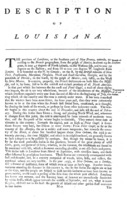 Giving a particular account of the climate, soil, minerals, animals, vegetables, manufactures, trade, commerce and languages, together with the religion, government, genius, character, manners and customs of the Indians and other inhabitants. Illustrated by maps and plans of the principal places, collected from the best authorities, and engraved by T. Jefferys, geographer to His Royal Highness the Prince of Wales.
 -
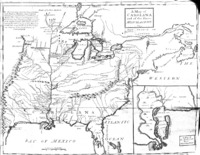 By the Spaniards call'd Florida, And by the French La Louisiane. As also of the Great and Famous River Meschacebe or Missisipi, The Five vast Navigable Lakes of Fresh Water, and the Parts Adjacent. Together With an Account of the Commodities of the Growth and Production of the said Province. And a Preface containing some Considerations on the Consequences of the French making Settlements there
 -
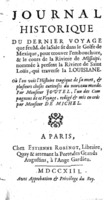
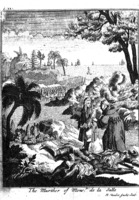
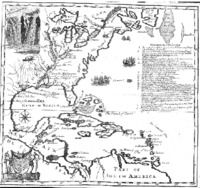 In 1684 Robert Cavelier, Sieur de La Salle, was planning an expedition to establish a French settlement at the mouth of the Mississippi River. Joutel met La Salle in Rouen and signed on as his "intendent" or confidential assistant. After a harrowing ocean crossing of over four months, La Salle and his party reached the Gulf of Mexico. Navigational errors caused them to miss the mouth of the Mississippi, instead making landfall in Matagorda Bay. La Salle was murdered by his crew during the journey back to the mouth of the Mississippi. Joutel, his nephew, and La Salle's brother escaped a similar fate, making their way to Tonti's fort on the Illinois River, travelling on to Quebec via the Great Lakes, and eventually returning to France in 1688. Shown here is the first French edition of Joutel's journal.
 -
-
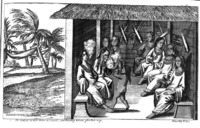 Giving an Account of the Author's Abode there, The Form and Make of the Country, the Coasts, Hills, Rivers, &c. Woods, Soil, Weather, &c. Trees, Fruit, Beasts, Birds, Fish, &c. The Indian Inhabitants, their Features, Complexion, &c. their Manners, Customs, Employments, Marriages, Feasts, Hunting, Computation, Language, etc.
 -
-
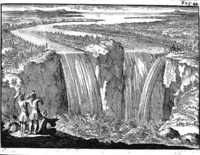
 Extending above Four Thousand Miles, between New France and New Mexico; with a Description of the Great Lakes, Cataracts, Rivers, Plants and Animals. Also, the Manners, Customs, and Languages of the several Native Indians; and the Advantage of Commerce with those different Nations … This is the English translation of Louis Hennepin's Nouvelle Decouverte d'un Très Grand Pays Situé dans l' Amérique (1697).
 -