
About "Higher Ground"
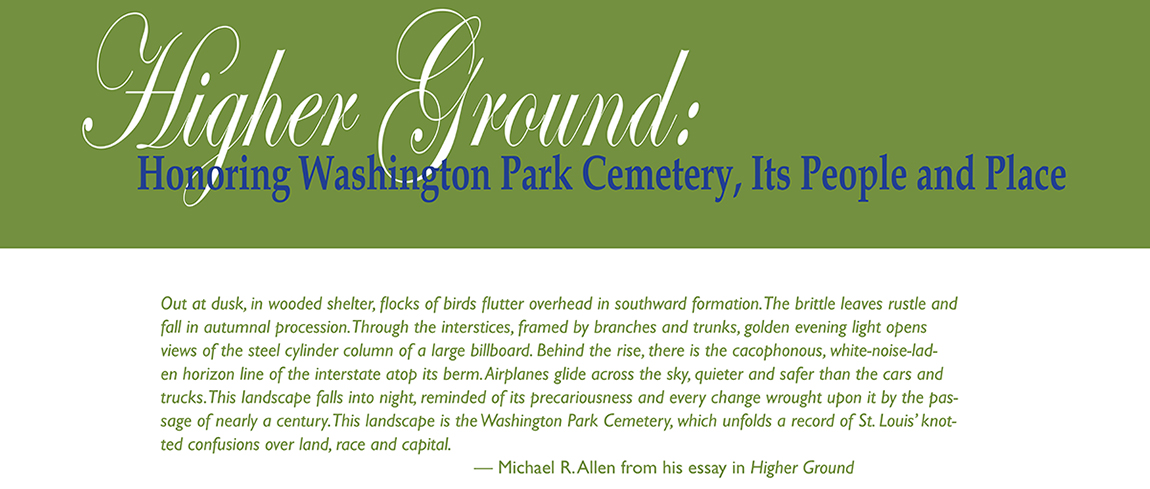
This multi-media exhibition, conceived by the photographer Jennifer Colten, includes 50 color landscape photographs by Colten, three videos by Denise Ward-Brown, a sculpture installation and animated film by Dail Chambers, historical background information and land documentation, which together provide an overview of the history and issues surrounding this historically African-American cemetery.
Washington Park Cemetery, located near St. Louis Lambert International Airport in the city of Berkeley, Missouri was established in 1920 as a burial ground for African Americans during a time of rigid segregation. Beautifully landscaped in the lawn-park cemetery tradition, for nearly 70 years it was the largest black cemetery in the region and the final resting place for many prominent African Americans, including Oscar Minor Waring, the first African-American principal of Sumner High School and Dr. Miles Davis, Sr., father of the great trumpeter.
Like many African-American cemeteries across the country, Washington Park has both a celebrated and a troubled past. In its almost 100-year history, the grounds of the cemetery went from elegant and manicured to disturbed and attenuated when major construction projects like the building of Highway 70 in 1955, and the airport expansion and the extension of the MetroLink light rail system in the 1990s invaded the once-bucolic landscape. The story is further complicated by neglect and mismanagement by past owners of the cemetery. Today, efforts are being made to restore what is left of the cemetery to its once beautiful state. The current owner, Kevin Bailey, whose father is buried there, bought the cemetery in 2009 with the goal of restoring the grounds in recognition of its historic significance. Several community groups and dedicated volunteers who come every weekend have helped in this cause. However, more help is needed. There are still large areas, particularly in the northern sections closest to Highway 70, that are overgrown and inaccessible.
This exhibition tells the story of the cemetery’s long and tragic history and reveals the complicated tangle of social injustice, racial politics and neglect that it has suffered. It aims to shed light on its history and reveal its importance to the city’s overall history.
A fully-illustrated exhibition catalogue and a dedicated resource web page hosted by Washington University Olin Library, Special Collections accompanies the exhibition. The original exhibit was built in 2017 using Omeka classic. In 2024, Washington University Libraries staff migrated the exhibit from Omeka classic to Omeka S. An archived version of the exhibit can be accessed here.
We want your memories, thoughts and photos! In the last room of the exhibit, we invite our visitors to share their experiences and family histories. You can also tweet your responses and memories to #WashingtonParkCemetery and bring or email a copy of a family photo with a connection to the cemetery to add to our memory wall. Email photos to plincoln@thesheldon.org and we will add them to the wall. Please include the name of the person to be honored. If you bring in a photo, please be sure it’s a copy and not an original, and include the person’s name on the back.