Items
41–52 of 52
Advanced search
-
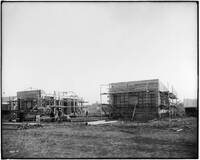 Building the China Government pavilion for the 1904 World's Fair Source Caption: A view from the north of the construction of China's pavilion for the Louisiana Purchase Exposition. The China Government pavilion consisted of several buildings surrounded by a garden. No. 1967.
 -
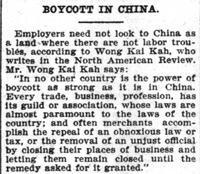 Boycott in China Starting with the Chinese Exclusion Act of 1882, a series of federal U.S. laws banned Chinese laborers from immigrating, and it made it illegal for Chinese nationals already in America to become naturalized citizens. Chinese immigrants had to register with immigration authorities and carry a Certificate of Residence with them, without which they could face deportation. The Exclusion laws not only impacted Chinese artisans here for the Fair but also the Chinese communities living in the heartland of America.
 -
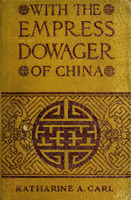 Book cover, With the Empress Dowager front cover
 -
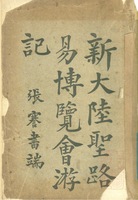 An Account of the St. Louis Exposition in the New World Previous catalogs described exhibits grouped by themes. Percebois added another system of categorization. In this catalogue, the Chinese exhibits were divided into several regional collections and exhibits, such as Hankow Collection, Shanghai Collection, Hupeh Provincial Exhibit. The catalogue became a display of China’s regional characteristics, so the reader learned about China overall.
 -
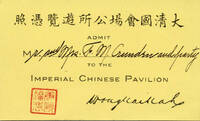 Admission to the Chinese Pavilion, 1904, for Mr. and Mrs. Frederick M. Crunden and guests Frederick M. Crunden was librarian of St. Louis Public Library in 1904. Entering the Chinese Pavilion required a ticket. Vice Commissioner Wong established this to limit crowding and possible damage to the detailed furniture and elaborate art inside
 -
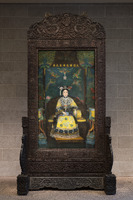 “The Empress Dowager, Tze Hsi [Cixi] of China.” Original oil on canvas with camphor wood frame, 297.2 × 173.4 cm (117 × 68.25 inches)
 -
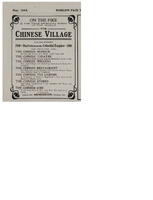 "On the Pike" Performance schedule for Chinese Village Parades were a daily occurrence at the Pike, the entertainment district of the Fair. Whether it was a march of the Jefferson Guards (the main police at the fair) a procession featuring indigenous peoples, or a scheduled dragon dance -- all became entertainment for fair attendees.
 -
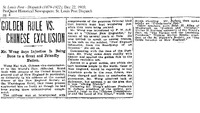 "Golden Rule vs. Chinese Exclusion" Starting with the Chinese Exclusion Act of 1882, a series of federal U.S. laws banned Chinese laborers from immigrating, and it made it illegal for Chinese nationals already in America to become naturalized citizens. Chinese immigrants had to register with immigration authorities and carry a Certificate of Residence with them, without which they could face deportation. The Exclusion laws not only impacted Chinese artisans here for the Fair but also the Chinese communities living in the heartland of America.
 -
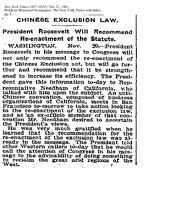 "Chinese Exclusion Law" Starting with the Chinese Exclusion Act of 1882, a series of federal U.S. laws banned Chinese laborers from immigrating, and it made it illegal for Chinese nationals already in America to become naturalized citizens. Chinese immigrants had to register with immigration authorities and carry a Certificate of Residence with them, without which they could face deportation. The Exclusion laws not only impacted Chinese artisans here for the Fair but also the Chinese communities living in the heartland of America.
 -
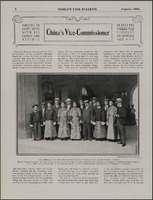 "China's Vice Commisioner" Wong arriving in St. Louis , with photos of Wong and delegation, his family, and his signature.
 -
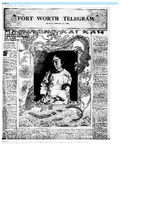 "A Celestial Ambassadress To The Occident" In newspaper interviews, Madame Wong expressed her desire to share Western ideas of femininity with Chinese women, hopeful they would travel, see the world, study different subjects, and generally not be confined to the home. Yet American media mainly focused on sensationalism and exoticism. Articles such as “A Poetical Trousseau” (Olneyville Times), “Ms. Wong’s Pretty Clothes” (Savannah Morning News), and “Wonderful Gowns” (Times Dispatch), meticulously described every stitch, ornament, and detail of the 300 embroidered gowns Madame Wong brought to St. Louis.
41–52 of 52